Infrared heaters: the benefits and the drawbacks
An even-handed look at infrared heating: what it does better than a radiator or heat pump, what it does worse, and when you should choose something else.
We make infrared heating, so treat what follows accordingly. But an article that only lists advantages is not useful to anyone actually making a decision, so here is the case on both sides.
How it works, briefly
Conventional heating warms air and relies on the air to carry heat to you. Infrared emits electromagnetic radiation in the far infrared band, which travels in straight lines, is absorbed by surfaces and people, and warms them directly. Those warmed surfaces then keep the room comfortable.
It is the mechanism by which the sun warms you on a cold clear day, and it is why you feel the difference stepping from shade into sunlight when the air temperature has not changed at all.
The benefits
1. Comfort at a lower air temperature
The main one, and the one everything else follows from. Because a large part of how warm you feel depends on the radiant temperature of your surroundings, you are comfortable with the thermostat set two to three degrees lower than a convection system needs. At roughly 6% less heating energy per degree, that is 12 to 18% for the same felt warmth.
2. Nothing to see
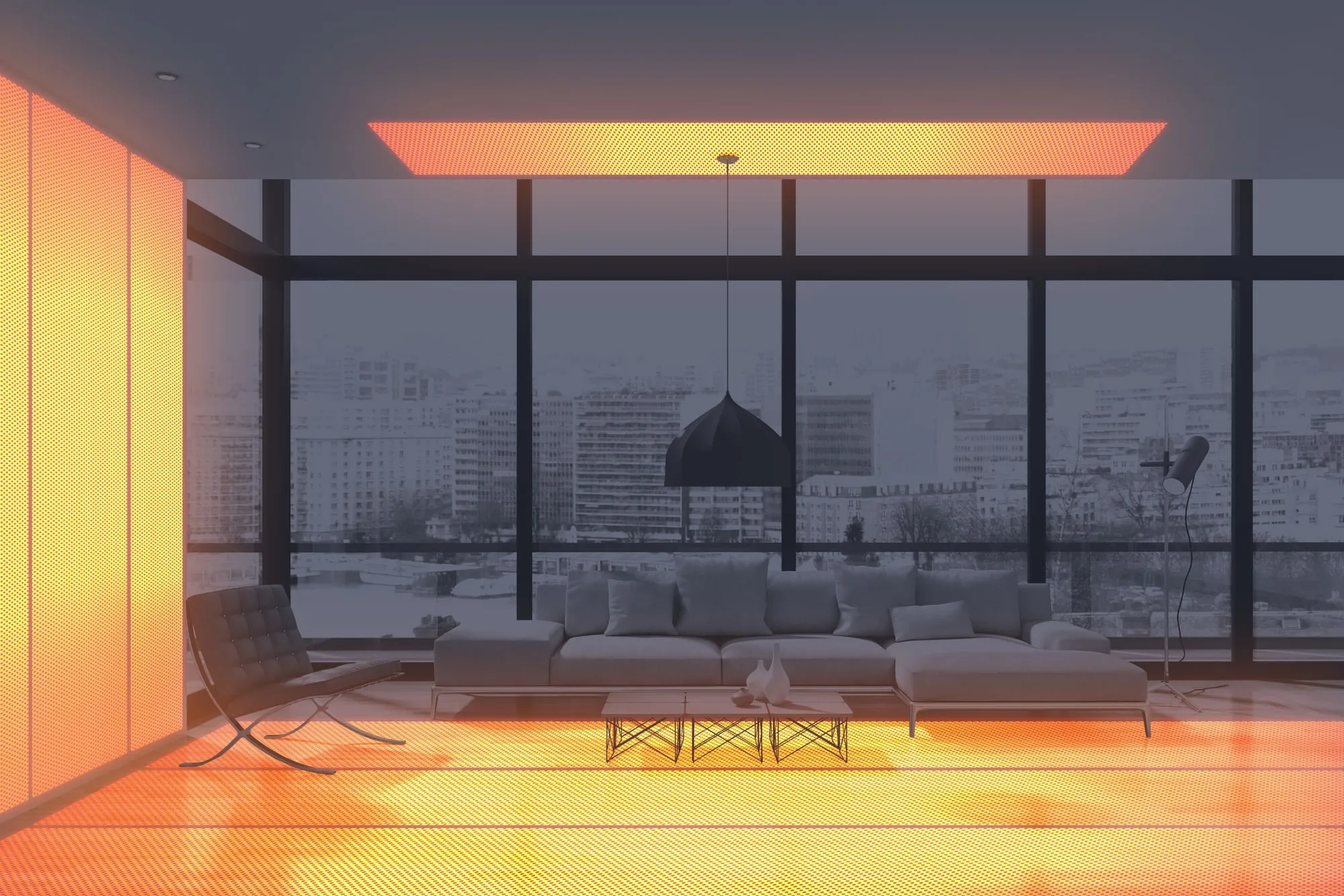
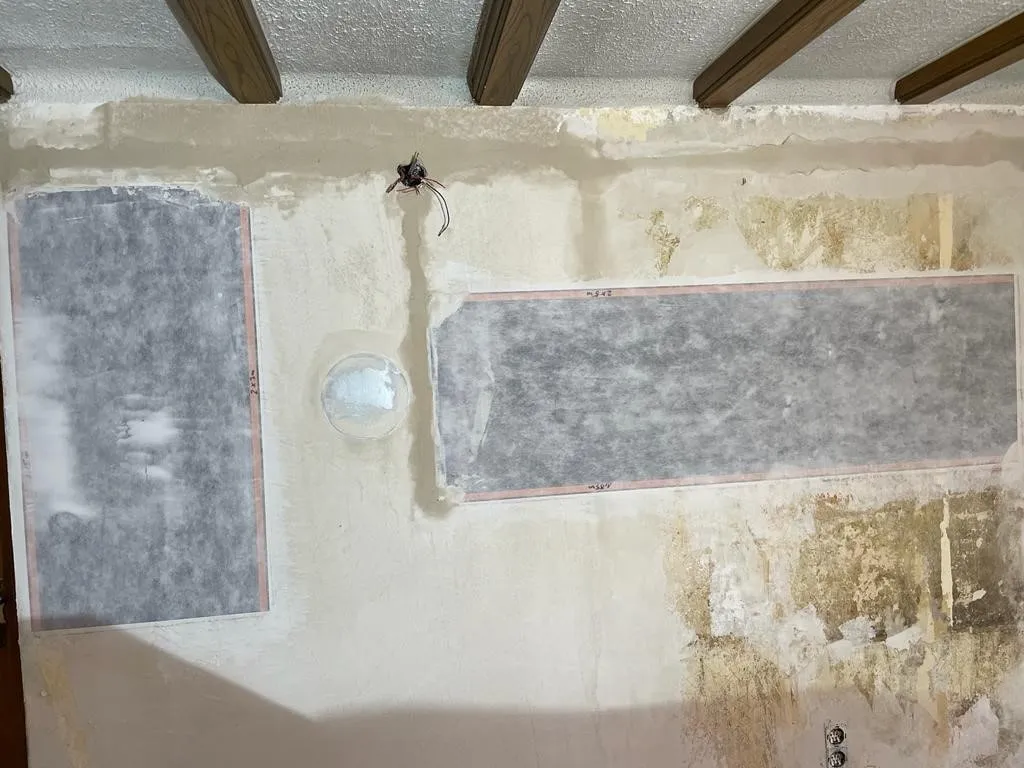
Our elements are buried: in the floor, behind the plaster, or in the ceiling. No radiators, no grilles, no wall-mounted boxes. Walls come back for furniture and pictures, and floor build-up stays shallow.
3. Simple installation, no maintenance
No pipework, no manifold, no pressure test, no plant room, no flue. A ceiling panel installs in around twelve minutes.
Afterwards there is nothing to service: no moving parts, no water, no filters, no annual visit. It is genuinely fit-and-forget, and our elements are built to be buried for the life of the building.
4. Better indoor air
Nothing is burned, so no combustion products. Nothing is blown, so dust and allergens stay where they fall. And because the air is not heated as hard, relative humidity does not collapse the way it does with forced air.
Research on particulates in heated rooms has found convective systems lifting airborne particle concentrations substantially, for the obvious reason: convection currents pick up whatever has settled and put it back in the air.
5. Silence
No fans, no pumps, no ticking pipework, no boiler firing at six in the morning.
6. Fast response and real zoning
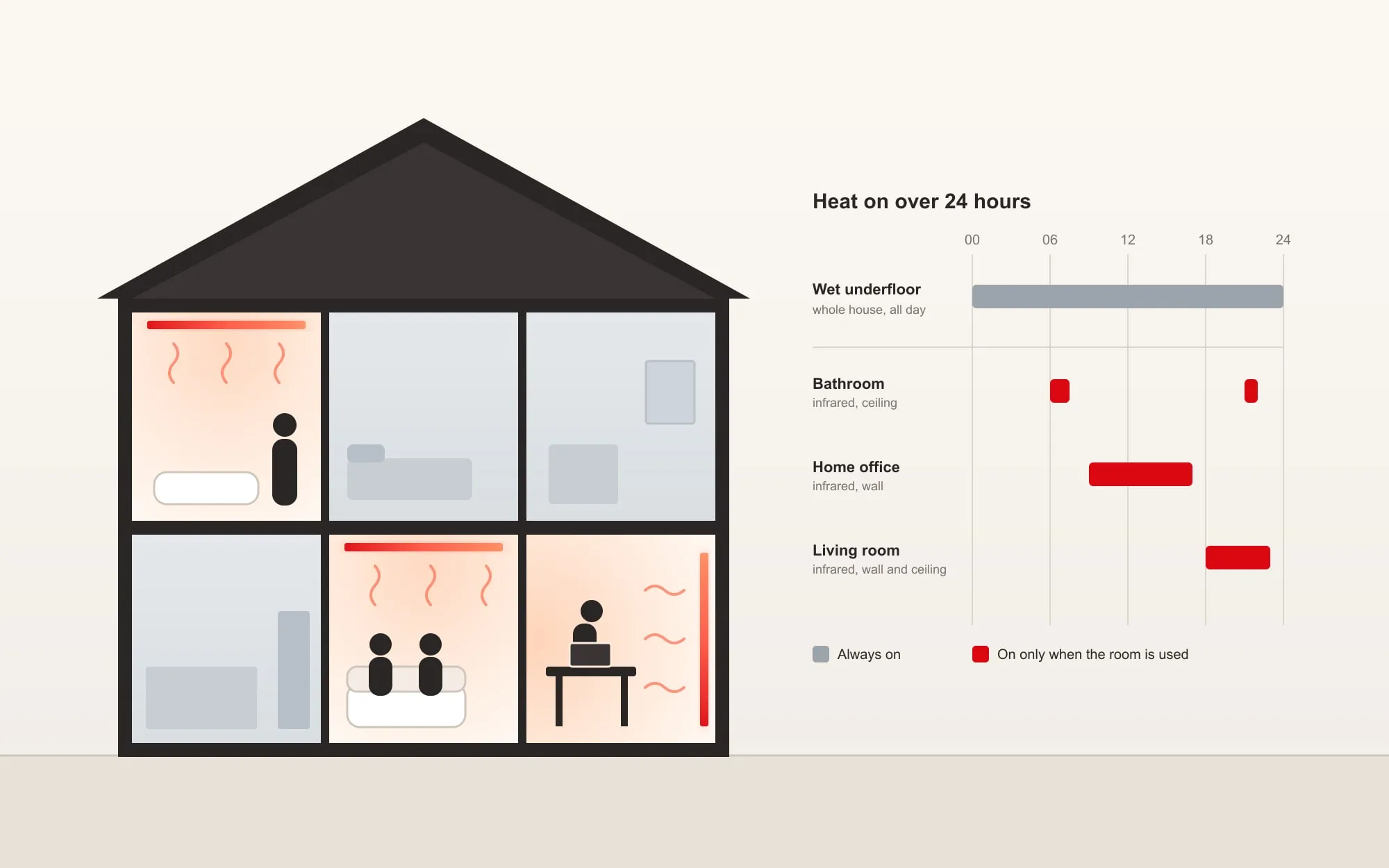
Minutes rather than hours to reach temperature, which means the system can be scheduled and zoned to how a building is actually occupied. In a large house or an intermittently used building, this is often the largest saving of all.
7. Long life
There is very little to fail. Independent longevity testing on our film, simulating twenty years of service, found its tensile strength had actually increased over the test.
8. It works alongside what you have
It does not need to be all or nothing. Infrared is frequently used to handle a cold extension, a converted loft, a bathroom, or a home office — the rooms a central system serves badly — while the existing system does the rest.
The drawbacks
Now the other side, honestly.
1. Electricity costs more than gas
Per kilowatt hour, in most markets, by a considerable margin. Anyone selling you infrared purely on running cost against a gas boiler is being selective.
The counter-arguments are real — you need fewer kilowatt hours, there are no standing losses, no flue losses, no annual service and no boiler to replace in twelve years — but if your only metric is pence per kilowatt hour, gas wins that line.
2. It is line-of-sight
Radiation travels in straight lines. A large piece of furniture in front of a wall element, or a partition between a panel and the people, blocks the heat. Placement matters much more than it does with a radiator, and rearranging a room can genuinely change how it heats.
3. It does not rescue a leaky building
An uninsulated building loses heat rapidly whatever the source, and radiant heating will not change that. Warm surfaces help with the felt experience and with damp, but a solid-wall property with single glazing needs fabric work first. We would rather say so than sell a system that disappoints.
4. Ceiling height is a constraint
Radiant intensity falls with distance. Ceiling systems work well up to about 3 to 3.5 metres; above that you need considerably more installed power, and the sensible answer is usually to heat the floor instead.
5. Surface-mounted panels can be uncomfortable
Standard panels run at 90 to 110 °C, which produces the “hot head, cold feet” sensation and a room warm in a beam and cool outside it. It is why we engineer our concealed systems around 55 °C instead.
That applies to our own range too. The surface-mounted PowerBoard 500 and 750 are small emitters, and they run at 80 to 105 °C. We recommend them only where a ceiling cannot be built, ideally on higher ceilings and away from where people sit for long periods.
6. Retrofitting means disturbing surfaces
Putting an element into a floor, wall or ceiling means getting to that floor, wall or ceiling. In a renovation where surfaces are already coming off, that is free. In a finished house you do not want to disturb, it is a real cost — and the case for surface-mounted panels instead.
When to choose something else
- Well-served by gas, no renovation planned, and cost per kilowatt hour is the only criterion. Keep the boiler.
- A large, poorly insulated building with no budget for fabric work. Insulate first.
- Very high ceilings with no floor access. Different problem, different solution.
When to choose it
- Renovating or building, where the surfaces are open anyway.
- Rooms a central system serves badly — extensions, loft conversions, bathrooms, home offices.
- Where wall space or build-up height is precious.
- Where you have solar or a battery, particularly with our low-voltage DC systems.
- Where installation disruption or programme time is the binding constraint.
- Where comfort is the point — because on comfort per degree, radiant heating is simply better, and that is not a marketing claim but a consequence of how the body loses heat.
If you want to know which category your building is in, send us a plan. We will tell you if the answer is no.