Is infrared heating cost effective? Running costs, worked out
Is infrared heating cost effective? Real running costs in euros for a whole home and room by room, compared with gas and heat pumps, with the working shown.
Is infrared heating cost effective? Yes, and mostly for a reason people don’t expect. It isn’t that electricity is cheap. It’s that infrared lets you heat one room, for the hour you’re actually in it, and have it warm in minutes.
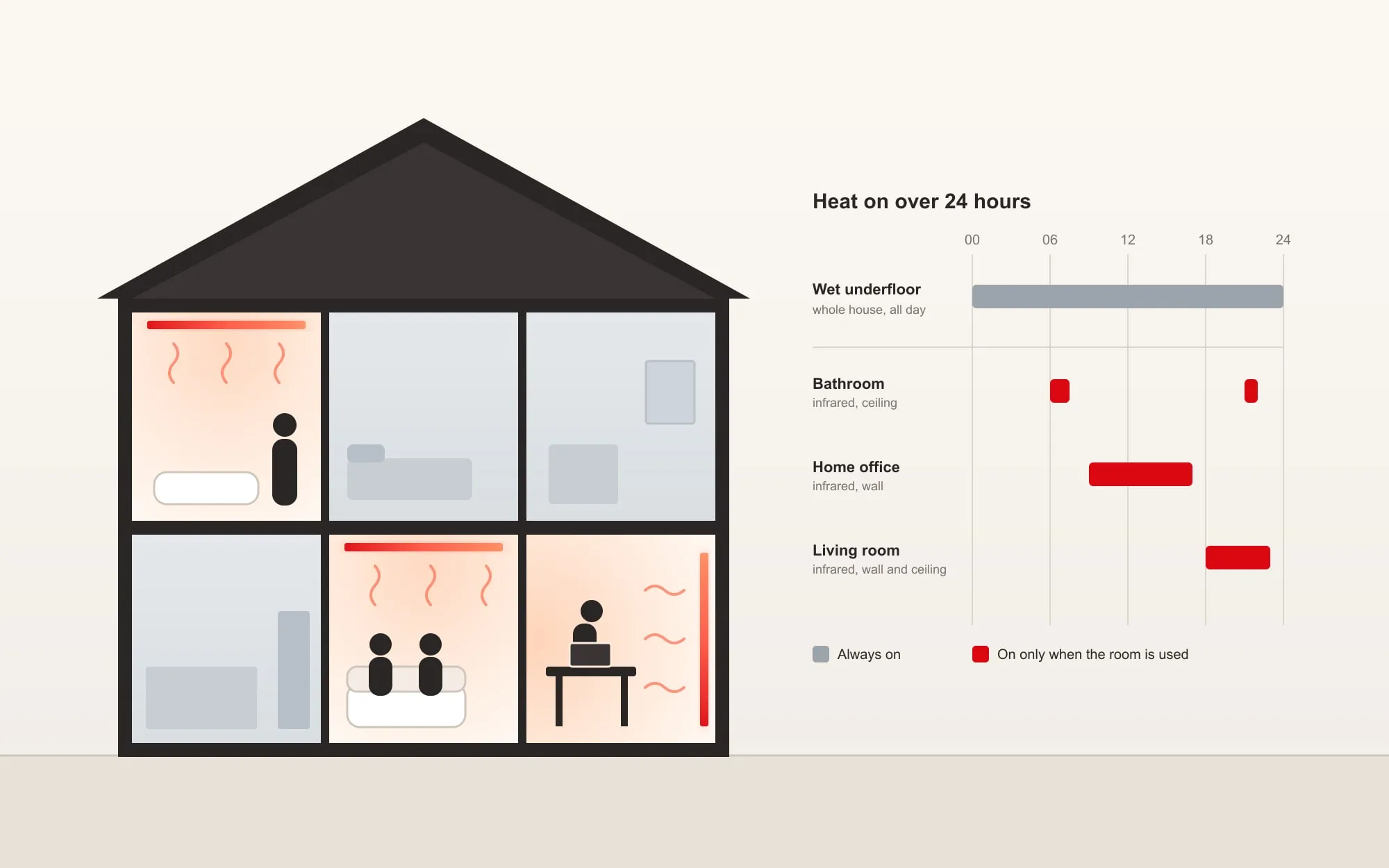
Most gas boilers and heat pumps in newer homes feed underfloor heating: water pipes buried in a thick layer of screed. That screed takes hours to warm up, so in practice those systems stay on all day and heat the whole house, whether anyone’s home or not. Heat only the rooms you use, when you use them, and infrared comes out cheaper to run than either of them. You also skip the boiler, the outdoor unit, the flue and the yearly service.
Where it doesn’t come out ahead is a big house with every room kept warm all day. There, a heat pump running well costs less per unit of heat.
Below we show the working, with real prices, so you can see which of those sounds like your home.
What actually sets the bill
Four things decide what infrared heating costs to run. Only one of them is the heater.
- How much heat your home loses. This one beats everything else. A well-insulated house can need a quarter of the heat of an old one with solid walls.
- How many hours it’s on. Heat for ten hours a day and you use less than half of what you’d use keeping the house warm around the clock.
- How many rooms you heat. Every room has its own thermostat, so a room nobody’s in can simply stay off.
- What you pay per kilowatt hour. We use the EU average for households: about €0.29 for electricity and €0.12 for gas, from Eurostat’s figures for the second half of 2025. Swap in your own price and the maths still works.
The heater itself matters less than you might think. Every electric heater turns 100% of the electricity it uses into heat; there’s no flue for anything to escape up. What infrared changes is how that heat reaches you, and so how much you need in the first place.
So be wary of anyone promising to take 50 or 70% off your bill just by switching to infrared. The saving is real, but it comes from needing less heat and running it for fewer hours, and on its own the heater can’t cut a bill by anything like that much.
Why you need less heat to feel just as warm
A radiator or a fan heater warms the air, and the air warms you. Infrared warms you and the surfaces around you directly, a bit like sunshine on a cold, clear day. Because the walls and floor are warmer, your body loses less heat to them, and the room feels comfortable at a lower air temperature.
Most people end up setting the thermostat two to three degrees lower than they would with radiators, and feel the same. The usual rule of thumb from European energy agencies is that every degree lower saves around 6% of your heating energy. So that’s roughly 12 to 18% less energy for the same comfort.
There’s a second saving when you compare floors. Our infrared floor heating uses 10 to 25% less energy than traditional underfloor heating, measured on the heat-up curve: a carbon fibre element spread across the whole floor warms up faster, and runs cooler, than pipes or cables laid in loops.
Walls and ceilings can save more still. They warm up faster than any floor and give off more of their heat as radiation, which is exactly what makes the lower thermostat setting possible. More on that further down.
What it costs to heat a whole home
These figures come from our energy estimator: how much heating power a home needs per square metre for its insulation standard, and how much of the time the heating is actually on once the rooms are warm.
The example is a 90 m² home, heated ten hours a day over a 210-day heating season, at the EU average of €0.29 per kWh.
| Type of home | Heat needed | kWh, 10 h a day | Cost, 10 h a day | Cost, 24/7 |
|---|---|---|---|---|
| Passive house | 30 W/m² | 850 | €247 | €592 |
| New build | 50 W/m² | 1,890 | €548 | €1,315 |
| Renovated | 75 W/m² | 3,544 | €1,028 | €2,466 |
| Partly renovated | 100 W/m² | 5,670 | €1,644 | €3,946 |
| Unrenovated | 120 W/m² | 7,938 | €2,302 | €5,525 |
Want to work it out for your own place?
floor area (m²) × heat needed (W/m²) ÷ 1,000 × hours a day × share of time on × days × your price per kWh
For the renovated example: 90 × 75 ÷ 1,000 = 6.75 kW. Heated ten hours a day, it’s on about a quarter of that time once the rooms are warm, so 6.75 × 10 × 0.25 = 16.9 kWh a day. Over 210 days that’s 3,544 kWh, and at €0.29 you get €1,028 for the season.
Two things stand out. The type of home makes more difference than anything you choose about the heating: the unrenovated house costs nine times as much as the passive one. And heating ten hours a day instead of around the clock cuts the bill by more than half.
What one room costs
The whole-home numbers assume every room is heated for the same ten hours. Nobody actually lives like that, and this is where infrared really earns its keep. Every room has its own thermostat and its own schedule, so the bathroom can be warm at seven, the office from nine to five, the living room in the evening, and everything else stays off.
These examples are for a renovated home. Each room runs at full power for the first half hour to warm up, then the thermostat holds it there, which takes around 30% of the time.
| Room | Size | Hours a day | kWh a day | Per day | Per season |
|---|---|---|---|---|---|
| Bathroom | 5 m² | 2 | 0.36 | €0.10 | €22 |
| Bedroom | 12 m² | 3 | 1.13 | €0.33 | €69 |
| Home office | 10 m² | 8 | 2.06 | €0.60 | €126 |
| Living room | 25 m² | 6 | 4.03 | €1.17 | €246 |
At 75 W/m², that’s 375 W of heating in the bathroom, 900 W in the bedroom, 750 W in the office and 1,875 W in the living room.
Add those four rooms up and you get about €460 a season, compared with €1,028 for heating the whole 90 m² home ten hours a day. A real zoned home lands somewhere in between, because a bit of heat always drifts from warm rooms into the ones you’ve left off. But that gap is the point: heating the rooms you use, when you use them, is the biggest saving infrared can give you, and it’s one a single boiler serving the whole house can’t easily match.
Take the home office. Heated on its own during the working day, it costs about 60 cents. Heating the whole house all day just to keep one room warm costs many times that.
How it compares with gas and heat pumps
Most comparisons put a heat pump’s efficiency rating next to a price per kilowatt hour and call it a day. That skips the two things that really decide what heating costs: how many hours it has to run, and how much of the heat it makes actually reaches you.
Underfloor heating with water has to stay on
Gas boilers and heat pumps in new and renovated homes mostly feed water underfloor heating: plastic pipe in loops, buried in 30 to 50 mm of screed or more. That screed stores heat. It takes hours to warm up and hours to cool down, so you can’t really switch it on for an evening and off again. Heat pumps make this even slower, because they work best with lukewarm water.
So in practice, water underfloor heating runs around the clock and keeps the whole house at temperature. Running it ten hours a day, or room by room, is either impractical or needs extra valves, controls and zone manifolds that cost money and still don’t fix the slow start. Want the bathroom warm at seven in the morning? It has to be heated all night.
Infrared has nothing to fill up first. A wall or ceiling element is warm to the touch within three to ten minutes and reaches its set temperature in twenty to thirty. That’s what makes heating by room and by hour possible, and it’s where most of the saving comes from.
A heat pump’s rating is measured at the machine, not in your room
Every electric heater, infrared included, turns 100% of the electricity it uses into heat. A heat pump does better than that at the machine: its COP (coefficient of performance) is usually between 2 and 3, meaning two to three units of heat for every unit of electricity. But that’s measured at the heat pump, outside your house. The heat still has to get from there to you, and some of it is lost at every step:
- Distance. Heat made outside travels through pipes, a buffer tank and a manifold before it reaches the floor, losing a bit along the way and keeping circulation pumps busy. Infrared makes its heat a few millimetres from the surface it warms. We’ve written about why that matters in proximity to surface.
- Pipes are lines, not surfaces. A pipe loop, like a heating cable, is a line of heat. It has to run hotter than the floor you want, so the screed can spread the warmth sideways between the loops, and hotter water means a lower COP. A carbon fibre element covers the whole surface and gives off its heat evenly at a lower temperature, with no hot and cold strips.
- Defrosting and standby. In cold, damp weather the outdoor unit regularly reverses to melt ice off itself, and pumps and controls keep running around the clock.
None of that makes a heat pump a bad system; the machine does what it says. But the COP on the datasheet describes the machine, not your room. There’s no honest single number for what arrives in the room, because it depends on the pipework, the controls and the house. What we can say for sure is that it’s lower, and that a heat pump gets its efficiency by running all the time.
Walls and ceilings beat any floor on speed
The same logic works within infrared. A heated floor has to warm up the flooring before you feel much, and only 20 to 30% of its heat reaches you as radiation. A heated wall gives 40 to 60% as radiation, and a ceiling 50 to 80%, depending on the product. Walls and ceilings also reach temperature in twenty to thirty minutes, against forty to sixty for a floor.
When you heat by the hour, that difference shows up on the bill. The bathroom from the table above costs about 10 cents a day heated from the ceiling. Heated from the floor, the first of its two hours mostly goes on warming the tiles, and it comes to about 14 cents, around a third more. So for rooms you only use for a short while, walls and ceilings are the efficient choice. Floors are great where warm tiles are the whole point, or in rooms you’re in for long stretches.
The comparison, with each system used the way it really is
Same renovated 90 m² home. Gas and heat pump with water underfloor heating, running around the clock like they do in real life. Infrared shown two ways: heating the whole home ten hours a day, and heating the four rooms above on their own schedules.
| System | How it runs | Energy bought | Cost per season |
|---|---|---|---|
| Infrared, room by room | 4 rooms on schedules | 1,591 kWh electricity | €461 |
| Heat pump, COP 3 at the machine | 24/7 | 2,835 kWh electricity | €822 |
| Infrared, whole home | 10 hours a day | 3,544 kWh electricity | €1,028 |
| Gas boiler + underfloor | 24/7 | 9,665 kWh gas | €1,160 |
| Heat pump, COP 2 at the machine | 24/7 | 4,253 kWh electricity | €1,233 |
What the chart is really telling you:
- Heated the way people actually live, a room at a time, infrared is the cheapest to run. It simply heats far fewer room-hours. That’s its real advantage, and no datasheet will show it.
- Even heating the whole home ten hours a day, infrared beats gas running around the clock at EU average prices. A heat pump at a COP of 3 comes in cheaper than that.
- A heat pump’s result swings a lot with its COP. At 3 it’s the cheapest way to heat the whole house all day; at 2, the bottom of its usual range, it’s the most expensive option in the chart. And both numbers are measured at the machine, before anything is lost on the way to your room.
- Against other electric heating (panel heaters, storage heaters, oil-filled radiators), infrared always wins, because it needs less heat for the same comfort and only runs when you need it.
What you don’t pay for
The running cost is only part of the story. With infrared, there’s simply no:
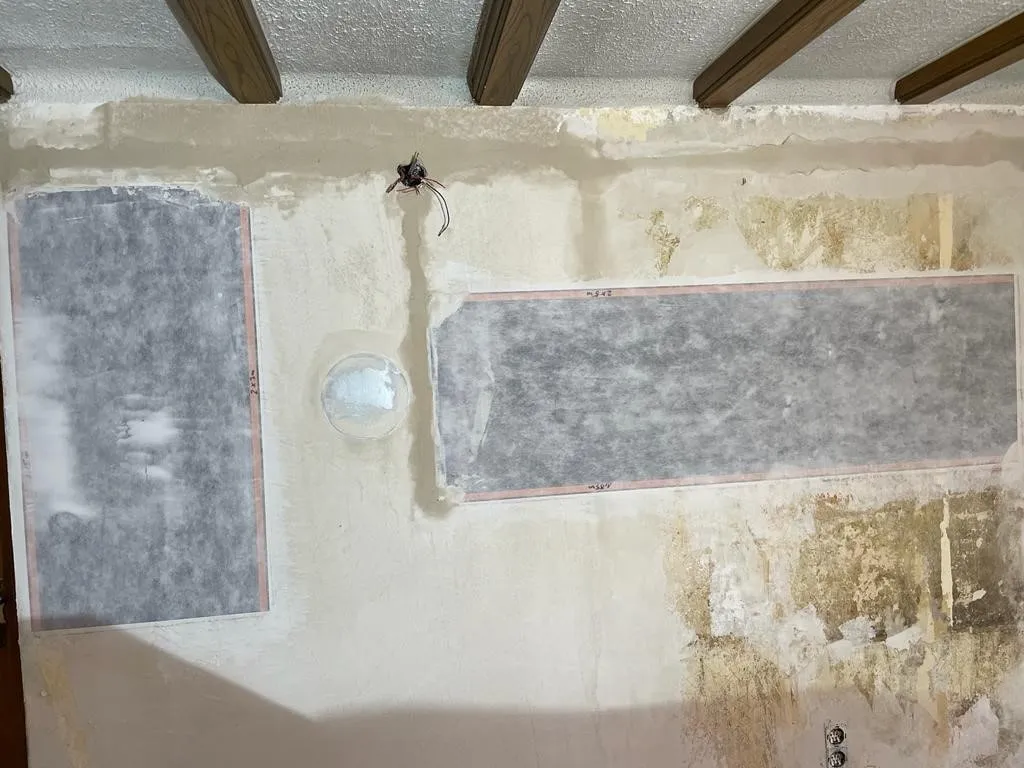
- Boiler, flue, pipework, radiators, manifold or outdoor unit. The element is a film 0.4 mm thick, behind the plaster, under the flooring or in the ceiling, connected by your electrician. It goes in as part of the plastering or flooring work that was happening anyway.
- Yearly service. Nothing moves, nothing burns, and there’s no refrigerant or water in the system. A boiler or heat pump needs servicing every year for as long as you own it.
- Short life. Our heating elements are tested for a lifespan of more than 20 years and come with a 10-year warranty.
- Gas connection in a new build, and no fixed charges for one.
Put that together and infrared often works out cheaper overall in exactly the homes where its running cost looks worst on paper: a small, well-insulated house, an apartment, an extension, a loft conversion, a holiday home you use a few weeks a year, or that one cold room the central heating never quite reaches. In those, you need so little heat that the difference in running cost is small, while the savings on installation and servicing aren’t.
Running it on your own solar power
If you have solar panels, or you’re thinking about them, infrared is a really good match. Our low-voltage ComfortScrim system runs from a power supply that takes either normal mains power or DC straight from your panels or a home battery. So your solar power reaches the heating without being converted to mains voltage and back again.
The honest catch is timing: you want heat on winter mornings and evenings, which is when panels produce the least. With a battery, or in spring and autumn when sunshine and heating overlap, a good share of your heating can run on your own electricity. And every kilowatt hour of that costs you nothing. More on infrared and solar.
When infrared isn’t the cheaper choice
We’d rather you heard this from us:
- A big, poorly insulated house heated all day. You need a lot of heat, all the time, and a heat pump will cost much less to run. Insulate first; the heating question looks very different afterwards.
- Tall spaces kept warm all the way up, like a warehouse held at one even temperature. Infrared works well in tall spaces when it warms the people in them, less well when the whole volume of air has to be warm.
- When you won’t use it room by room. Much of the saving comes from heating only the rooms you’re in. Run everything as one big zone around the clock and you give that away.
So, is infrared heating cost effective for you?
It probably is if most of these sound like your home:
- It’s well insulated, or you’re insulating it now
- You use rooms at different times, or parts of it sit empty for long stretches
- There’s no gas supply, or you’re getting rid of it
- Fitting a boiler or heat pump would mean major building work
- You have solar panels, or you’re planning to
- It’s a new build, an extension, a loft, an apartment, or one room that needs heat
The easiest way to find out is with your own numbers. Send us the plan and we’ll work out the heat needed room by room, where the heating goes, what it will use and what it costs.
Infrared heating costs: your questions
Can infrared heating reduce my energy bill?
Yes, but not by switching the heater alone. Every electric heater turns electricity into heat one for one. The saving comes from three things: you feel as warm with the thermostat two to three degrees lower, which saves roughly 12 to 18% of the energy; the heating warms up in minutes, so it can be off whenever nobody needs it; and every room has its own thermostat, so empty rooms stay off. Heating only the rooms you use is by far the biggest of the three. If your home loses a lot of heat, insulating it first saves more than any heating system.
Is infrared heating cheaper than gas?
Usually, yes, once you look at how each one is really used. Gas with water underfloor heating has to run around the clock because the screed takes hours to warm up; in a renovated 90 m² home that costs about €1,160 a season at EU average prices, plus a yearly service. Infrared heating the whole home ten hours a day costs about €1,028, and heating just the rooms you use, when you use them, about €460.
Is infrared heating cheaper to run than a heat pump?
When you use it room by room, often yes. A heat pump’s COP of 2 to 3 is measured at the machine outside the house, and some heat is lost on the way to your room through pipes, buffer tanks, pumps and defrosting. With underfloor heating it also has to run around the clock. Heated room by room, infrared cost about €460 a season in our example, against €822 to €1,233 for a heat pump, and it needs no outdoor unit and no yearly service. If you want every room warm all day, a heat pump running at a COP of 3 is cheaper.
How much does infrared heating cost to run per hour?
Multiply the heater’s power by how much of the time it’s actually on, then by your electricity price. A 375 W bathroom heater that’s on about 30% of the time once the room is warm uses around 0.11 kWh an hour, roughly 3 cents at the EU average of €0.29. A whole 90 m² renovated home heated ten hours a day averages about 1.7 kWh an hour, around 49 cents.
Is infrared cheaper than storage heaters or panel heaters?
Yes. All electric heating turns electricity into heat one for one, but infrared gives you the same comfort at an air temperature two to three degrees lower, which saves roughly 12 to 18% of the energy. It also warms up in minutes, so it’s only on when you need it, instead of charging up overnight for a day you might not even be home.
Is infrared floor heating cheaper than traditional underfloor heating?
Our infrared floor heating uses 10 to 25% less energy than traditional underfloor heating, measured on the heat-up curve, because a carbon fibre element across the whole floor warms up faster and runs cooler than pipes or cables. Infrared on walls and ceilings can save even more, since they reach temperature in 20 to 30 minutes and give off more of their heat as radiation.
How long does infrared heating last?
Our carbon fibre heating elements are tested for a lifespan of more than 20 years and come with a 10-year warranty. There are no moving parts, no water and nothing that burns, so there’s no yearly service either.
Can infrared heating run on solar panels?
Yes. Our low-voltage ComfortScrim system runs from a power supply that takes DC straight from solar panels or a home battery, as well as normal mains power. Without a battery the overlap is mostly sunny spring and autumn days; with one, a good share of a small home, or a single room, can run on your own electricity.