Thermal comfort explained: thermal neutrality, ASHRAE 55 and why radiation matters
What thermal comfort really is: the six factors in ASHRAE 55, PMV and PPD, mean radiant temperature, and why warm surfaces make a room feel warmer.
Ever sat in a room where the thermostat says 21 °C and you still feel chilly? Or stepped into winter sunshine and felt warm even though the air was freezing? Both come down to the same thing: comfort isn’t a temperature. It’s a balance between the heat your body makes and the heat it loses, and the air is only part of that story.
When your body hits that balance without having to work at it, you feel comfortable. The technical name for it is thermal neutrality. This article explains what that means, how the international comfort standard ASHRAE 55 measures it, and why the temperature of the surfaces around you matters as much as the air.
What is thermal neutrality?
We’re warm-blooded. Your body keeps its core at around 37 °C and your skin at around 31 to 34 °C, whatever the weather. To do that it constantly balances the heat you produce against the heat you lose.
When the room is too cold, your body works to keep heat in: blood vessels near the skin narrow, and eventually you shiver. When it’s too warm, it works to get rid of heat: more blood to the skin, then sweat. Thermal neutrality is the state in between, where your body doesn’t have to do either. You don’t notice the temperature at all. That’s what comfort actually is.
The comfort standard ASHRAE 55 puts it in human terms: thermal comfort is a state of mind, the feeling of being satisfied with your surroundings. It’s personal, which is why two people in the same room so often disagree about the thermostat.
How your body loses heat
At rest, indoors, heat leaves your body in four ways, and one of them does most of the work:
- Radiation, about 60%. Your body radiates heat to every surface around you that’s cooler than your skin: walls, windows, floor and ceiling. You don’t have to touch them. This is why you feel a cold window from across the room.
- Evaporation, about 22%. Moisture leaving through your breath and skin, even when you aren’t sweating.
- Convection, about 15%. Air moving across your skin and carrying heat away.
- Conduction, about 3%. Direct contact, like bare feet on cold tiles.
These are typical figures for a person resting indoors in normal clothes, and they shift with activity, air movement and humidity. But the order doesn’t change much: radiation is the biggest way you lose heat indoors. So the temperature of the surfaces around you has a huge effect on how warm you feel, often more than the air.
That’s where most heating falls short. Radiators, fan heaters and warm-air systems work mainly by heating the air. The air warms up, but the walls and windows can stay cool, and your body keeps radiating heat to them. You feel it as a chill you can’t quite explain, and the usual fix is to turn the thermostat up.
The six factors of thermal comfort
ASHRAE 55 says six things decide whether you feel comfortable. Four are about the room, two are about you.
Air temperature. What the thermostat reads. It matters, but it’s only one of six.
Radiant temperature. The average temperature of all the surfaces around you, properly called the mean radiant temperature. Because radiation is your biggest route of heat loss, this one pulls a lot of weight. Cold walls make a warm room feel cool; warm walls make a cool room feel comfortable.
Air speed. Moving air carries heat away faster, which is great in summer and horrible in winter. Draughts are one of the most common comfort complaints of all. More in air speed in the built environment and wind chill.
Humidity. Very humid air makes it harder to lose heat by evaporation; very dry air dries out your eyes, nose and skin. Most people are comfortable between roughly 40 and 60% relative humidity. More in radiant heating and humidity.
Activity, or metabolic rate. The more you move, the more heat you make. It’s measured in met: sitting quietly is about 1 met. More in why some people run hot and others cold.
Clothing. Measured in clo. Typical winter indoor clothing is about 1 clo, light summer clothing about 0.5. More in how clothing plays a role in the thermostat wars.
None of these works on its own. Change one and the others shift to find a new balance. That’s why there’s no single “right” room temperature, only a comfortable combination.
The ASHRAE 55 comfort scale: PMV and PPD
So how do you put a number on something as personal as comfort? In the 1970s the Danish researcher Ole Fanger asked thousands of people how they felt under carefully controlled conditions, and turned the answers into a model that ASHRAE 55 and the European standard ISO 7730 still use today.
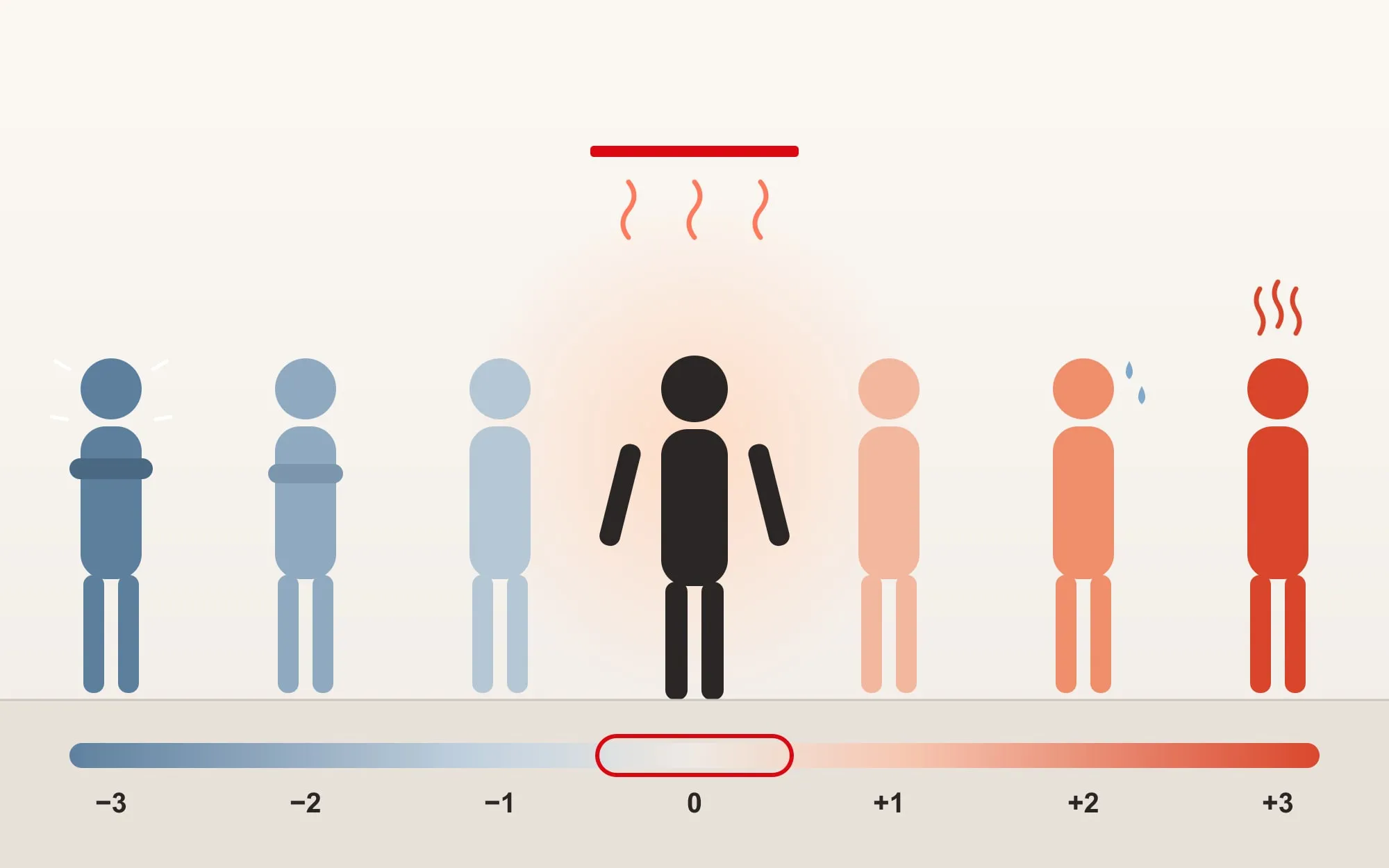
People rate how they feel on a seven-point scale, from −3 (cold) through 0 (neutral) to +3 (hot). Fanger’s model takes the six factors and predicts two things:
- PMV, the Predicted Mean Vote: where on that scale the average person would put themselves.
- PPD, the Predicted Percentage Dissatisfied: how many people would still be unhappy.
Two things in that curve are worth knowing:
- Nobody pleases everyone. Even at perfect neutral, the model predicts about 5% of people will still be unhappy. Someone is always a little too warm or a little too cold.
- The comfort band is narrow. ASHRAE 55 treats conditions as comfortable when PMV sits between −0.5 and +0.5, which keeps the dissatisfied under about 10%. Step one point off neutral and it’s already around a quarter of people.
Because a whole building can never suit everyone at once, the most reliable way to keep people comfortable is to let each room, and ideally each person, adjust their own conditions.
The standard also looks at local discomfort: one part of your body feeling different from the rest. The classics are a draught on your neck, cold feet on a cold floor, a big difference in air temperature between your head and your ankles, and a strong radiant difference, like sitting next to a cold window. For floors, ASHRAE 55 suggests a surface temperature of roughly 19 to 29 °C for people wearing shoes.
Operative temperature: why warm surfaces count
Here’s the idea that ties it all together. Because you lose heat both to the air and to the surfaces around you, what you actually feel is a mix of the two. That mix is called the operative temperature. At normal indoor air speeds it’s simply the average of the air temperature and the mean radiant temperature:
operative temperature ≈ (air temperature + mean radiant temperature) ÷ 2
That means you can reach the same comfort in two ways: by heating the air a lot, or by warming the surfaces.
In the first room the air is a toasty 22 °C, but the walls and windows average 16 °C. What you feel is about 19 °C, and it feels cool. In the second room the air is only 19 °C, but a heated wall and ceiling bring the surfaces up to around 23 °C. What you feel is about 21 °C, and it feels comfortable. Same comfort, or better, with air three degrees cooler.
That’s why most people set the thermostat two to three degrees lower with radiant heating and feel just as warm. And since every degree lower saves around 6% of your heating energy, that works out at roughly 12 to 18% less energy for the same comfort. We work through the costs in is infrared heating cost effective?
How radiant heating uses this
Infrared heating in a wall, ceiling or floor raises the mean radiant temperature directly. Instead of heating the air and hoping it warms the surfaces, it warms the surfaces and lets them warm you, the same way the sun does on a cold, clear day.
Our short film shows how that works in a room:

A few things follow from the comfort science:
- Warm surfaces, cooler air. You get the same or better comfort at a lower air temperature, which is where the energy saving comes from.
- Less air movement. Radiant heat doesn’t rely on circulating warm air, so there are fewer draughts and less dust carried around, and the air near your head isn’t much warmer than the air at your feet.
- Walls and ceilings are the most radiant. A heated floor gives about 20 to 30% of its output as radiation, a heated wall 40 to 60% and a ceiling 50 to 80%, depending on the product. Walls and ceilings also reach temperature faster. Why a ceiling runs at around 55 °C is explained in why 55 °C ceiling surface temperature.
- Room by room. Since every room has its own thermostat, people who like it warmer and people who like it cooler can each have their way, which is about as close to that 5% minimum as a home can get.
For the physics of how it works, see how does infrared heating work?, and for how we apply it, why infrared.
Thermal comfort: your questions
What is thermal neutrality?
Thermal neutrality is the state in which your body is losing heat at the same rate it produces it, without having to shiver, sweat or change blood flow to the skin to stay balanced. You don’t notice the temperature at all. It is what we experience as being comfortable.
What is ASHRAE 55?
ASHRAE 55 is the international standard for thermal comfort in buildings, published by the American Society of Heating, Refrigerating and Air-Conditioning Engineers. It sets out the six factors that decide comfort, uses the PMV and PPD model to predict how people will feel, and defines the conditions most people will find comfortable. The European equivalent is ISO 7730.
What are the six factors of thermal comfort?
Air temperature, mean radiant temperature, air speed and humidity describe the room. Metabolic rate, meaning how active you are, and clothing describe you. Comfort comes from the combination, so there is no single right room temperature.
What do PMV and PPD mean?
PMV, the Predicted Mean Vote, predicts where the average person would rate a set of conditions on a seven-point scale from minus 3, cold, to plus 3, hot. PPD, the Predicted Percentage Dissatisfied, predicts how many people would still be unhappy. Even at a perfect PMV of 0 about 5% are dissatisfied; ASHRAE 55 treats PMV between minus 0.5 and plus 0.5, under about 10% dissatisfied, as comfortable.
What is operative temperature?
Operative temperature is the temperature you actually feel, combining the air temperature and the temperature of the surfaces around you. At normal indoor air speeds it is roughly the average of the air temperature and the mean radiant temperature. Warm air with cold walls can feel cooler than cooler air with warm walls.
What is mean radiant temperature?
Mean radiant temperature is the average temperature of all the surfaces you exchange heat with by radiation, such as walls, windows, floor and ceiling, weighted by how much of your surroundings each one takes up. Because radiation is the largest way your body loses heat indoors, it has a big effect on how warm you feel.
Why do I feel cold when the thermostat says 21 °C?
Usually because the surfaces around you are cold. The thermostat only measures air temperature, but most of the heat you lose indoors goes by radiation to the walls, windows and floor. If they are cool, you lose heat to them and feel cold even when the air is warm. Draughts and low activity make it worse.