
Electric infrared underfloor heating: two systems
ComfortScrim at 12–48 V and SafeTech EGS at mains voltage: build-up, output, where each belongs, the trade-offs, and whether a heated floor is safe.
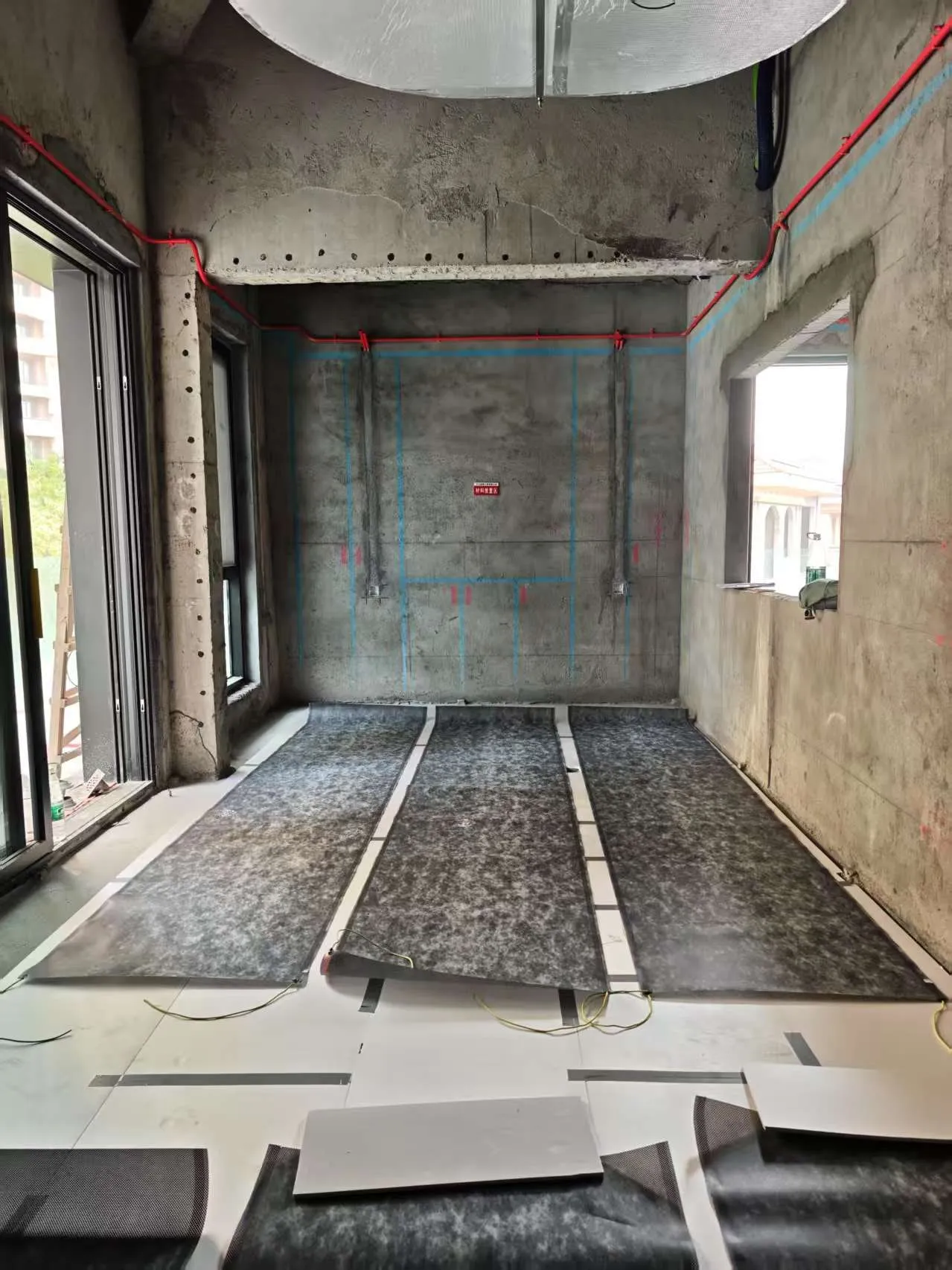
We supply two electric infrared underfloor heating systems. ComfortScrim runs at 12 to 48 V from a central power supply and goes into the levelling compound. SafeTech EGS runs at 110 to 240 V straight off a circuit and comes as discrete pre-cabled heaters. Both are full-surface carbon fibre, both add a few millimetres, and both disappear under the finish.
They are not interchangeable. The choice is made by the floor finish, by which trades are already booked, and by whether the building has a sensible place to put a power supply. This article sets out what each one is, where it belongs, what it costs you in return, and what makes a heated floor safe to bury under a room.
Carbon fibre against heating cable
A conventional electric floor is a resistance cable laid in loops at a fixed spacing. All the heat for the room leaves through the surface area of that cable, which is small, so the cable runs hot — typically well above 60 °C — and the screed above it has to spread that heat sideways before any of it reaches the room. The spacing has to be right, the depth has to be right, and damage anywhere along the run is concentrated in one place.
A carbon-fibre element covers the whole floor area instead of a fraction of it. The same room output is spread across roughly ten times the emitting surface, so the element runs at a much lower temperature, and the heat travels upward as far infrared rather than sideways through the slab. Practical consequences: a shallower build-up, a faster response, no strips of floor that are warmer than others, and no single conductor carrying the whole load.
The lower operating temperature is also why the safety question is answered by construction rather than by thermal cut-outs alone. Nothing in the floor is hot enough to be a hazard on its own. What matters is keeping water away from the conductor and giving any fault somewhere to go.
The two systems at a glance
| ComfortScrim floor | SafeTech EGS floor | |
|---|---|---|
| Voltage | 12 to 48 V, from the Multi Zone Power Supply | 110 to 240 V AC, direct to circuit |
| Supplied as | Roll, 600 and 900 mm wide, cut to the drawing | Discrete heaters, made to length |
| Build-up | 2 to 3 mm in levelling compound or adhesive | 1.4 mm dry (5.4 mm at the connection), or embedded up to 5 cm |
| Output | 80 to 220 W/m² | 80 to 220 W/m² |
| Needs a power supply | Yes | No |
| Certification | CE, UKCA | CE, UKCA, tested to UL 2683 |
| Typical use | Bathrooms, wet rooms, buildings with PV or battery | Floating and dry finishes, tiled and screeded floors |
ComfortScrim: low voltage under the levelling compound
ComfortScrim is the 0.4 mm element we also install behind plaster on walls and ceilings. On a floor it is rolled out across the slab, taped down and embedded in the levelling compound or tile adhesive that was going down anyway. It adds 2 to 3 mm. Rolls come in 600 and 900 mm widths and are cut to the layout drawing before delivery.
Power comes from a Multi Zone Power Supply at 12 to 48 V, one zone per room. This is safety extra-low voltage, which is the reason we specify it for bathrooms and wet rooms without further discussion: at those voltages the system is not capable of delivering a dangerous shock, whatever happens to the floor above it.
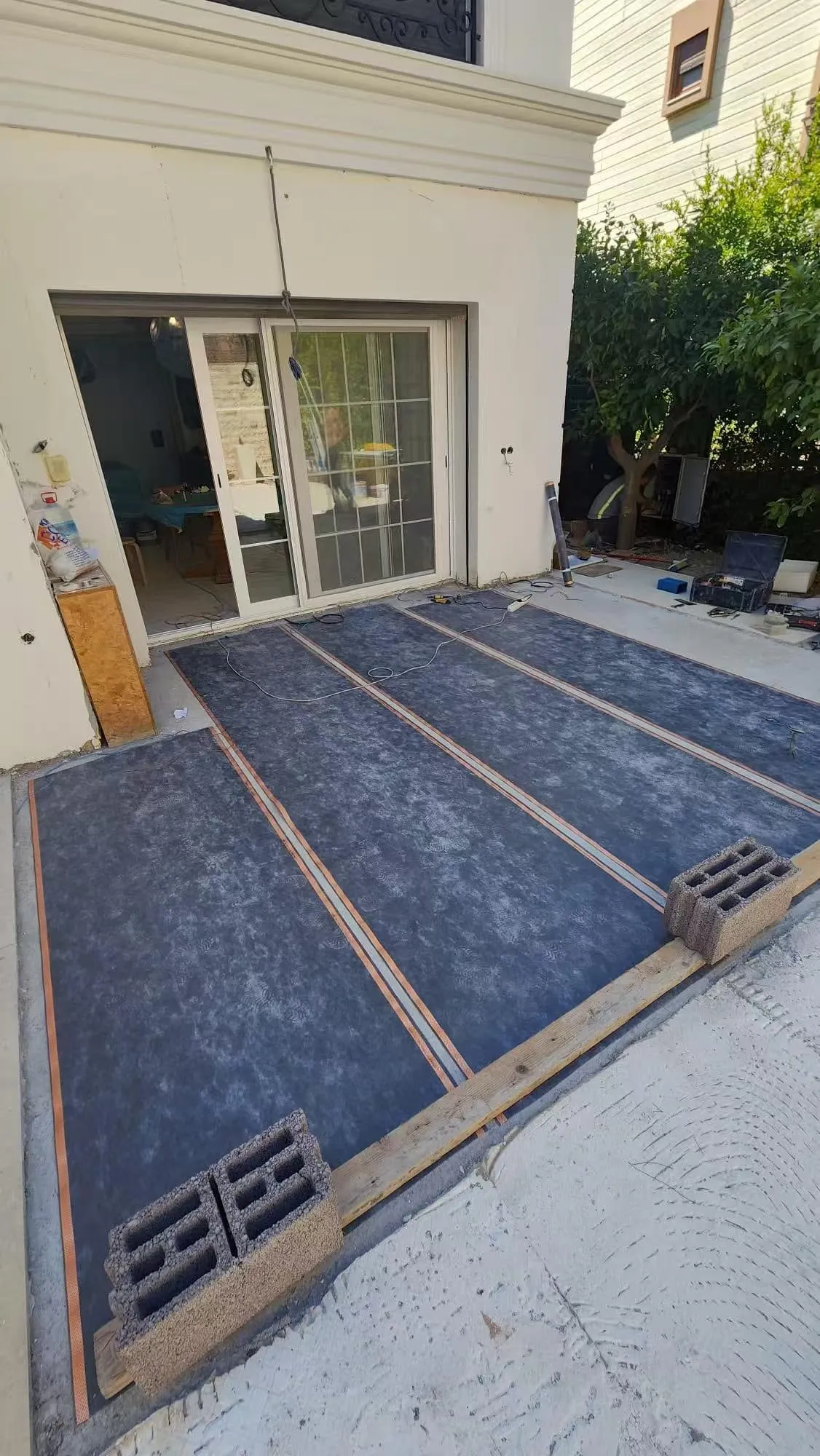
Element laid out in bays with the bus bars run along each edge, before the screed goes down. Bursa, Türkiye.
In its favour. The thinnest build-up of anything we make, so it suits renovation where floor levels are fixed at doorways and thresholds. Safety extra-low voltage removes the wet-room argument entirely. A 48 V DC element takes power from a battery without an inverter, which matters if the building has solar and storage. And because walls and ceilings run on the same supply and the same zones, a whole-house scheme can be controlled as one system.
Against it. The power supply is real equipment that needs a location, a budget line and ventilation — a cupboard, a utility room, a plant space. Low voltage also means high current for the same power, so conductor sizing and run lengths matter and the supply has to sit reasonably close to the zones it feeds; a long thin run wastes power as heat in the cable. The rolls are cut to a drawing, which keeps decisions off site but also means the layout is settled before delivery. If the room changes after the kit ships, the kit is wrong.
SafeTech EGS: mains voltage in discrete heaters
SafeTech EGS runs straight off a 110 to 240 V circuit. There is no power supply and no transformer, so nothing has to be housed and no low-voltage distribution has to be designed.
It is supplied as individual heaters rather than a roll. Each is made to length — 600 or 900 mm wide, one to three metres long, according to the wattage density specified for the room — fully encapsulated, pre-cabled, and joined to the next through an IP68 connector. A floor is laid out and connected in one pass, with no cutting and no wiring decisions on site.
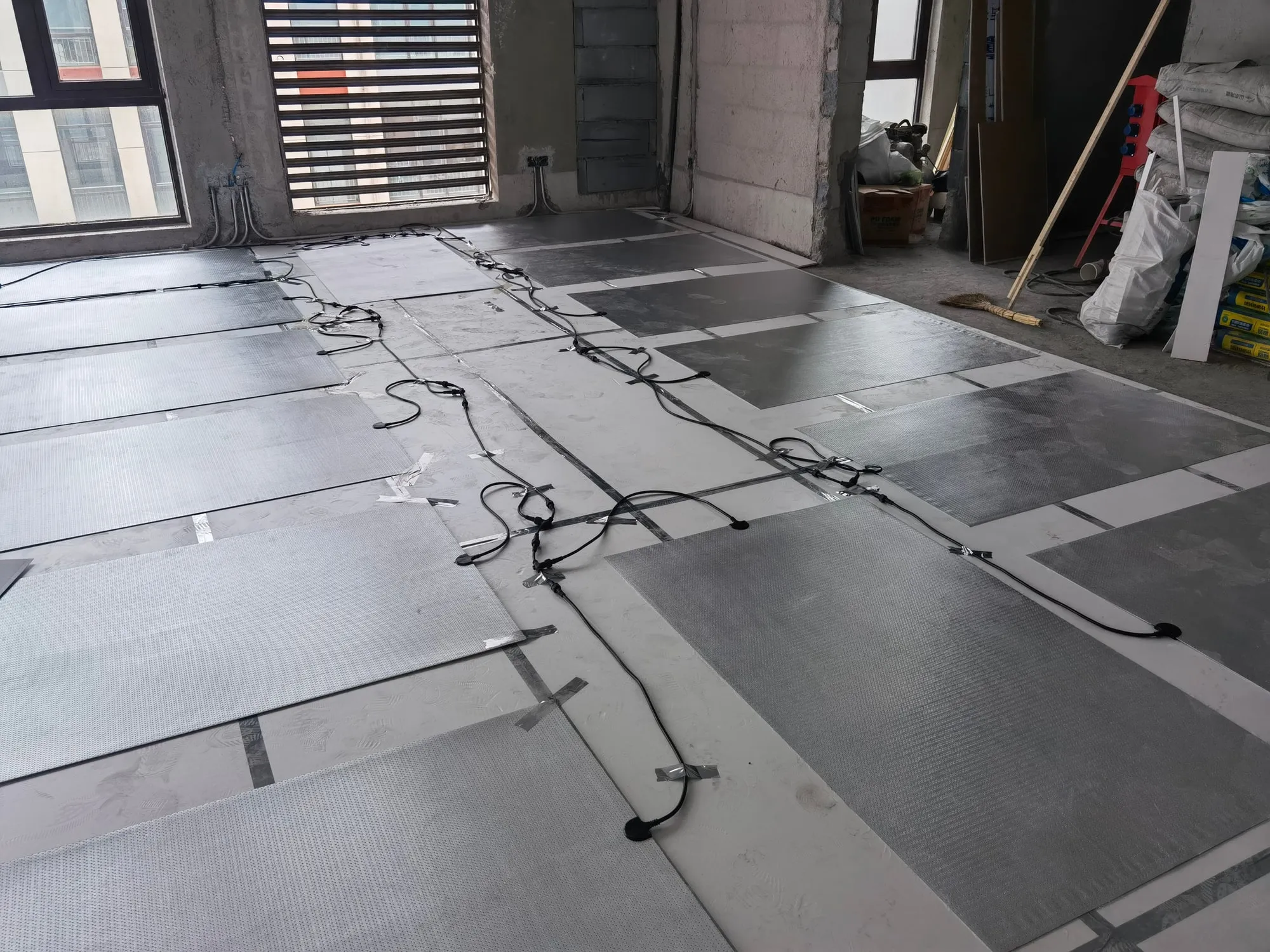
Discrete EGS heaters set out and daisy-chained to the design plan, Jinan.
Because it is a mains-voltage product sitting inside a floor, the encapsulation does the work. It comes in two thicknesses, and specifying the wrong one is the error we correct most often.
Thick overmoulding (EGS21E), for embedding under the levelling layer
The heavier encapsulation goes beneath the levelling compound or screed, under tile, stone and resin. Its 12 mm connection overmoulding is concealed within that layer, and it withstands the trowel and the weight of the screed above it, up to 5 cm. Each element comes with a 1.5 m 3-core cable and gland. Specify it for tile, stone, resin and screeded floors. If a wet trade is coming to the room in any case, this is almost always the right choice.
Thin overmoulding (EGS21F), for dry and floating floors
The thin version is a 1.4 mm film, 5.4 mm at the connection, intended for floating floors: laminate, engineered wood, click vinyl. The heater is laid on top of a 4 to 6 mm underlayment and the finish goes straight over it. Where needed, it can also go under tiles, in the tile adhesive bed. Each element comes with three 5 m silicone double-insulated cables back to a distribution box.
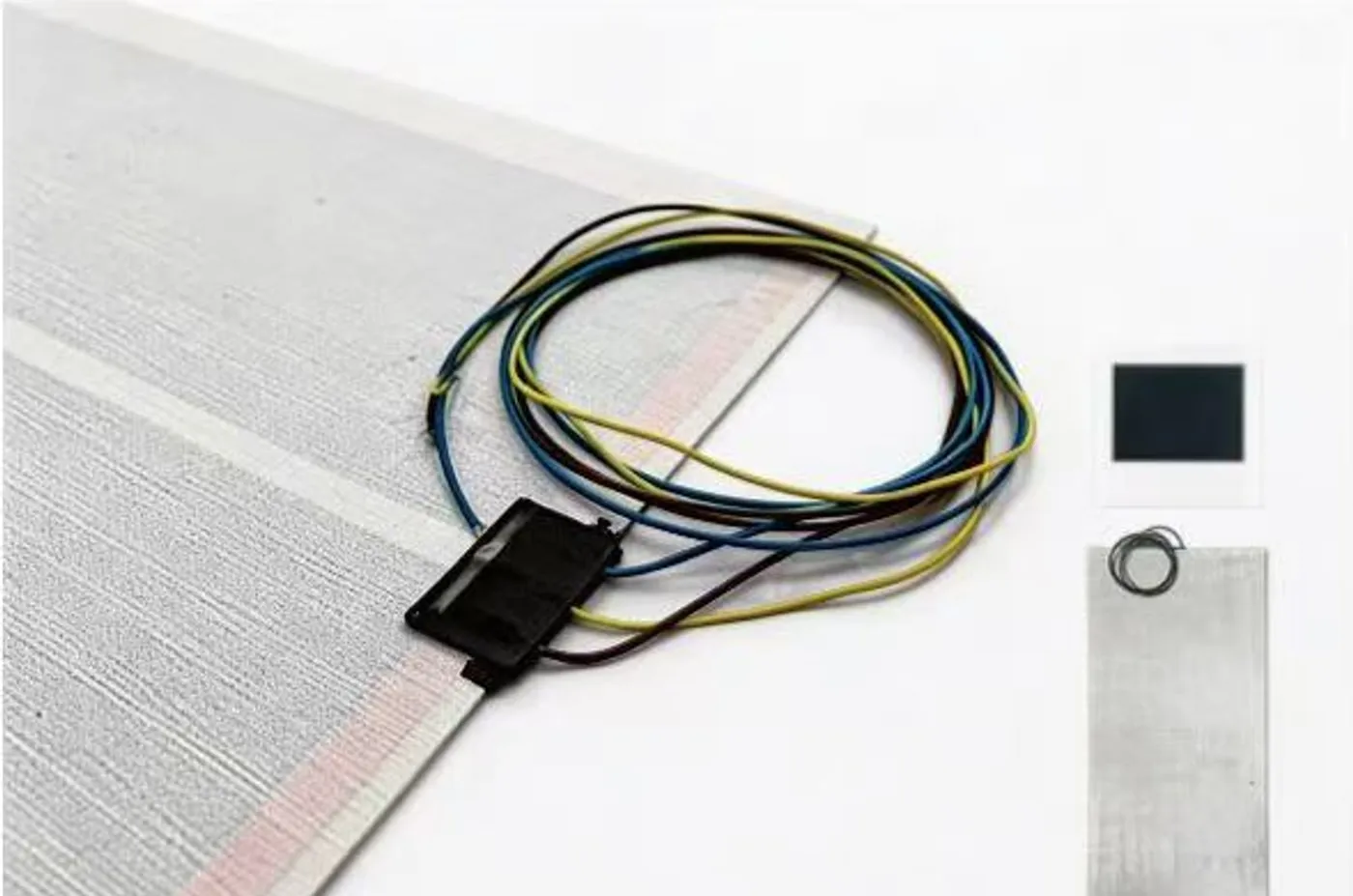
The thin-overmoulded kit: heater, cable tail, floor sensor and thermostat.
Do not put the thin version under screed. It is not built for the trowel, and it is designed to sit under a floating floor or in a tile adhesive bed, not fifty millimetres under screed. Where the finish is not yet decided, specify thick.
In its favour. No power supply to house, no transformer, and connection by a normal circuit means an ordinary electrician can complete the work. The plug-and-play chain goes down faster than rolls once the floor area gets large, which is why we specify it on open-plan commercial work. It is tested to UL 2683, the North American standard written for heating elements of this type. And the two overmouldings between them cover wet and dry construction, so one product serves most finishes.
Against it. Mains voltage inside a floor requires RCD protection and a competent electrician, which is not a burden but is not optional either. The heaters are made to length, so the layout is fixed when the order is placed — there is no trimming a heater to fit a changed alcove. Only elements below 140 W/m² are UL conforming, so North American projects are specified below that limit and given greater coverage to reach the same room temperature. Where the element is embedded in screed the build-up is deeper than ComfortScrim’s, which can matter at a threshold.
How the layers stack up
Both systems sit directly beneath the finish rather than deep in a slab, with insulation board underneath to push output upward instead of into the structure. That short distance between element and surface is what gives the floor a response measured in minutes.
Wet installation
Element embedded in levelling compoundDry installation
Element laid under a floating finishBoth build-ups work with low-voltage ComfortScrim and with mains-voltage SafeTech EGS. Which one you use comes down to the finish you have chosen and to whether wet trades are coming to the room anyway. A floating finish needs no adhesive bed.
Is a heated floor safe?
Voltage is the first answer and construction is the rest of it.
- Full-surface grounding. An aluminium layer runs across the entire element rather than along a bonding strip, so a fault anywhere in the element meets a grounded plane immediately above or below it. UL 2683 requires 75% coverage; ours covers the whole surface.
- UL 2683. SafeTech EGS is tested to it. It is the North American standard written specifically for heating elements of this type, and it is not a self-declaration.
- Insulation resistance above 500 MΩ. Factory tested, measured at 968 MΩ. This is the figure that confirms the conductor and everything around it stay properly separated.
- IP68 connections. The connectors between heaters are rated for continuous immersion, which is what is required of something buried under a wet screed.
- Flame-retardant construction and an overheat cut-out. The element cannot run away, and where conditions above it change — a rug, a mattress, a stack of boxes — the cut-out acts before the temperature does.
- Safety extra-low voltage on ComfortScrim. At 12 to 48 V the system cannot deliver a harmful shock in the first place.
The tests behind those claims are filmed: the element held in direct flame, submerged and energised, grounded, high-potential tested, then flexed and punctured to establish what it takes to break it.
SafeTech · five tests every element passes
Safety is not a claim we make about the system. It is a set of tests the element itself passes, filmed in our own laboratory, and the certifications that follow from them.
- Direct flame test
Fire resistance
The element is held in direct flame. It does not sustain a flame or propagate one along the film.
- Submerged and energised
Water immersion
Submerged and energised. Zero moisture absorption, which is what lets the element go into a bathroom or a wet room.
- Grounding test
Full-surface grounding
A grounded conductive layer across the whole element rather than a wire with a sheath, so a fault anywhere on the surface is carried to earth.
- HIPOT test
High-potential test
Every element is HIPOT tested before it leaves the factory, at multiples of its working voltage.
- Flex and puncture test
Structural integrity
Flexed, punctured and pulled. A damaged area is spliced in place and re-tested rather than replaced.
What both systems share, including the drawbacks
Neither product is a heat store. Both respond in minutes and cool in minutes, which suits rooms heated when they are occupied and does not suit a strategy built around overnight storage tariffs. Both need insulation below the element; without it a share of the output goes into the slab and never reaches the room. And both are electric resistance heating, so while every kilowatt-hour drawn becomes heat in the room, the running cost follows the electricity price, which is higher per unit than gas in most markets. Whether that nets out in your favour depends on the building, the tariff and how the rooms are used, which is what a layout and a heat loss calculation are for.
Choosing between them
- Bathrooms and wet rooms — ComfortScrim. Safety extra-low voltage, and the compound is going down regardless. There is a whole article on heating a bathroom this way.
- Buildings with PV or battery — ComfortScrim at 48 V, taking DC from storage without an inverter.
- Laminate, engineered wood, click vinyl — SafeTech EGS21F, thin. No wet trade required.
- Tile, stone, resin, screed — SafeTech EGS21E, thick.
- Large open floors — SafeTech EGS. Plug-and-play modules go down faster than rolls at scale.
- Walls or ceilings heated in the same project — ComfortScrim, so everything runs on one supply and one set of zones.
MAPEI publish a build-up recommendation for laying the element with their primers, levelling compounds and adhesives, covering each substrate and each floor finish. It is on the floor heating page alongside the datasheets.
Send us the floor plan and the construction and we will tell you which system we would specify and why, with a room-by-room heat loss behind it. Get a layout for your plan, or read how infrared heating works for the physics.
Two further articles go deeper on safety: are infrared heaters safe covers the general case, and is far infrared heating safe deals with the radiation itself.