Infrared heating for bathrooms: warm tiles, dry towels, nothing on the wall
Infrared heating for bathrooms, built into the wall, floor and ceiling. How it keeps towels dry without a rail, why low voltage makes it safe in a wet room, what it costs to run, and how the layers go together.
You step out of the shower and the room has not caught up with you. The tiles are cold underfoot. The towel you hung up yesterday is still faintly damp. The towel rail is warm in one strip, the rest of the room is not, and it is sitting on the wall where you wanted a cabinet.
Almost every bathroom works like this, and it is worth asking why we put up with it. A towel rail is a small radiator doing two jobs at once. It warms the room slowly, dries a towel slowly, and takes a wall to do it.
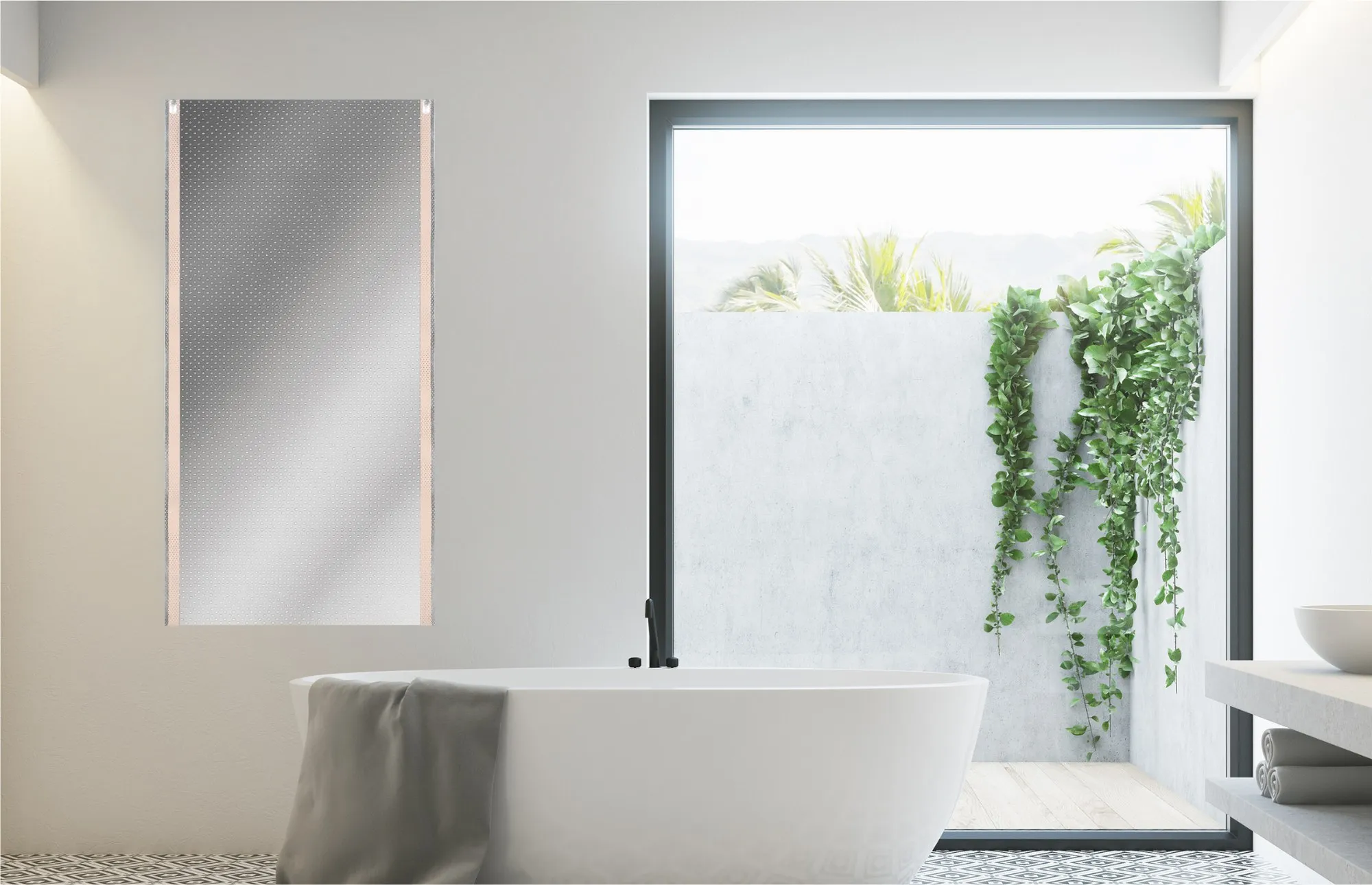
There is another way. Infrared heating for a bathroom goes inside the wall, the floor and the ceiling, where you cannot see it. The element is a carbon fibre film four tenths of a millimetre thick. It goes on under the tiles or under the plaster, and once the room is finished there is no sign of it. The floor is warm when you step on it. The towels dry. The walls are yours again.
Why bathrooms are hard to heat
Bathrooms ask for things no other room asks for, all at once.
You use them for ten minutes at a time, usually first thing, and you want them warm straight away. Nobody is going to heat a bathroom for two hours in advance.
You stand in them with bare feet on tile or stone, which pulls heat out of you faster than any other surface in the house. A cold floor makes a room feel cold however warm the air is.
They fill with steam, and the walls are often the coldest in the house. Warm wet air meets a cold tile, gives up its moisture, and you get condensation in the corners, black spots in the grout and towels that never quite dry.
And there is nowhere to put anything. Between the basin, the cistern, the shower screen and the mirror, a bathroom wall is spoken for before the heating gets a look in.
Safe in a wet room, because of the voltage
This is a heated surface in a room full of water, and it is safer than the towel rail it replaces.
ComfortScrim runs at 12 to 48 volts. Your phone charger is in that territory. The mains never enters the room: a power supply mounted elsewhere in the house takes the 230 volts, isolates it, and sends low voltage to the element. Electricians call this SELV, safety extra-low voltage, and it means the heating in your wall cannot give anyone a dangerous shock, whatever happens to the room around it.
Inside a shower enclosure we drop it further and specify under 24 volts.
The low voltage buys you two things you would not otherwise get.
You can drill into it. Once the room is finished you will want to hang a mirror, a rail, a shelf, a cabinet. You can drill through the heated area, up to a 70 mm hole, with no risk to whoever is holding the drill and without stopping the heating working. The element is a webbed mesh rather than a solid sheet, so the current goes around the hole.
It belongs in a wet room. The element is carbon fibre, which does not absorb water and cannot rust. We test it submerged and switched on. That is why a bathroom is the normal place for this system rather than a special case that needs arguing over. ComfortScrim is CE and TÜV certified and RoHS compliant.
Where it goes in your bathroom
Behind the towel rail
The wall behind the rail becomes the heat source, and the rail goes back to being somewhere to hang a towel.
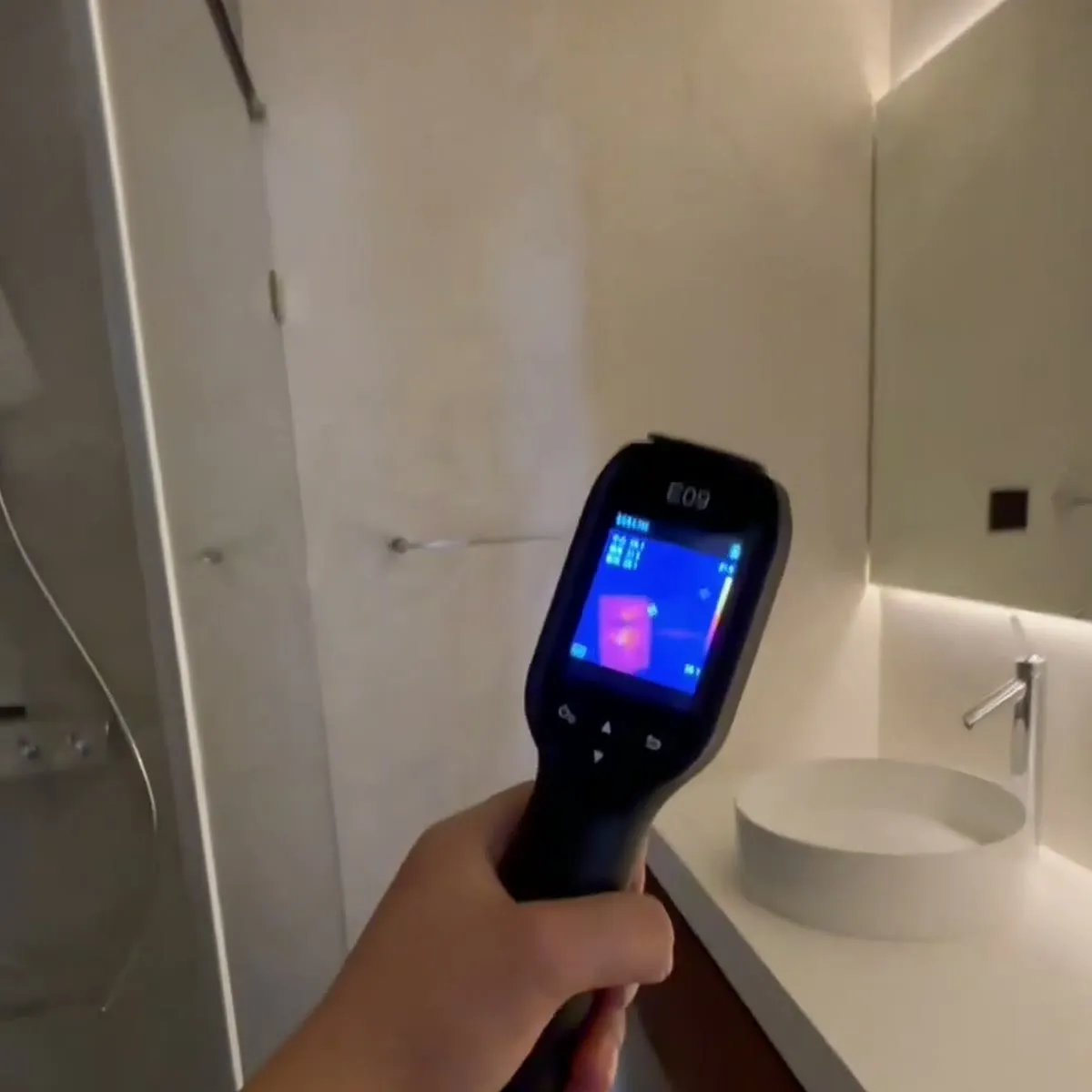
This is the change people notice most. A towel hung on a warm wall dries between uses. A towel hung on a cold wall stays damp all day, and a damp towel is what makes a bathroom smell. You get what you wanted from a heated rail without the rail being hot, and nothing in the room sits above about 55 degrees at the surface, so there is nothing a child can burn a hand on.
The walls, and behind the WC
Most bathrooms have one wall with nothing on it and one cold wall facing outside. Those are the two to heat.
The element goes on as part of the tiling or plastering, adds two to three millimetres, and gets covered over. Your tiler or plasterer does the work. Afterwards it is a wall like any other, and you can tile it, paint it, or hang something on it.
You do not need to cover every wall. A fifth to a third of the room surface is usually enough.
The ceiling above the bath
A ceiling has nothing in front of it and nothing fixed to it, so the heat reaches you directly wherever you stand. Lying in the bath, you feel it the way you feel sun through a window.
It is also the easiest thing to add to a bathroom that is otherwise finished. If the tiles and the floor are staying put, the ceiling can still be done.
And the floor
For most bathrooms we would start with the floor, because warm tiles underfoot are what people actually want even when they describe it as wanting a warm room. The element goes into the levelling compound or tile adhesive that was going down anyway. In a small bathroom the floor on its own can heat the whole room. In a bigger one, put the floor in for the warmth underfoot and add a wall or the ceiling to bring the room up quickly.
What the layers look like
Bathroom infrared heating goes in three places, and each has its own build-up: a tiled wall, a plasterboard ceiling, and a tiled floor.
Tiled bathroom wall
The element sits in the adhesivePlasterboard ceiling
The element sits in the plasterTiled bathroom floor
The element sits under the compoundOn the tiled wall the adhesive does the work in two passes. Your tiler combs on a bed, presses the film into it while it is still wet, then closes it in with a second pass before the tiles go on. Two to three millimetres of adhesive in total, which is roughly what a tiled wall gets anyway.
The ceiling is the same idea in plaster: a millimetre of plaster, the film pressed into it, a millimetre over the top, then paint. The two coats key through the perforations in the film and bond to each other, so you end up with one continuous layer rather than two coats with something sandwiched between them.
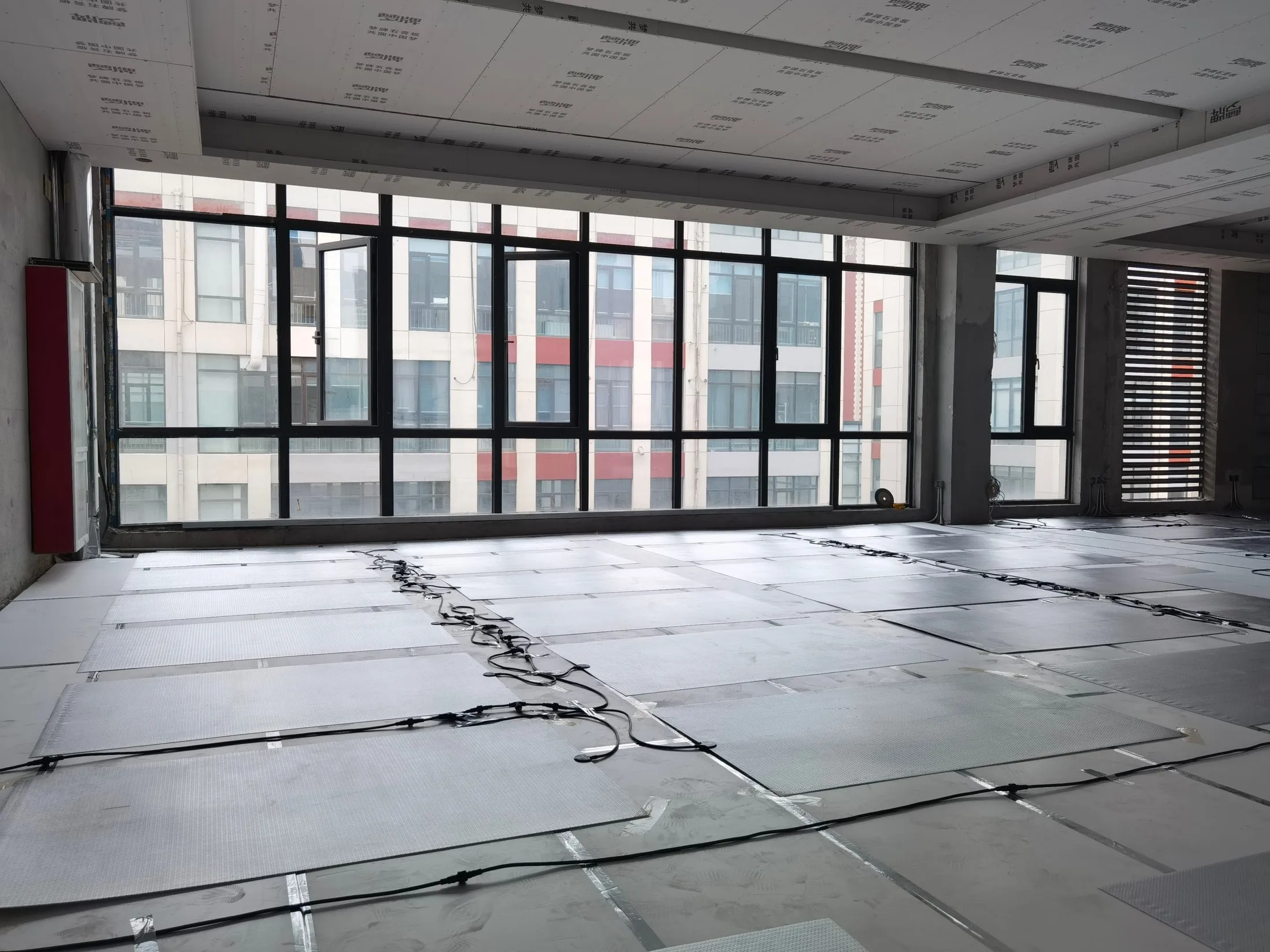
The floor has the most in it, because a bathroom floor has to keep water out as well as heat in. There are two waterproof layers. A damp-proof membrane goes over the existing floor, under the insulation, to stop moisture coming up from the substrate. Then the insulation, then the element rolled out across it and pressed into the levelling compound, and then tanking over the top of the heated floor before the tiles are bedded on. The tanking is the layer that matters most in a shower or wet room, and it goes in to its own manufacturer’s instructions; your installer should confirm the detail against the system you are using.
Adhesive choice matters here, and it is not a place to improvise. MAPEI publish a full recommendation for laying our elements with their primers, levelling compounds and adhesives, and you will find it on the floor heating page alongside the datasheets. We have also written up what to look for in an adhesive and why a heated surface changes the answer.
Warm before you get there
Warm-up time only matters if you are standing there waiting. In practice you are not, because the heating comes on before you do.
A bathroom needs two slots a day, and they are the two most predictable slots in the house: an hour or so in the morning, an hour or so in the evening. Set those and you stop thinking about it.
Each room runs on its own. Every room has its own thermostat and its own schedule, and one power supply can run up to five of them. The bathroom can come on at half past six while the bedrooms stay off and the living room waits until seven.
Start it a little early. A wall or ceiling gets to temperature in twenty to thirty minutes, a floor in forty to sixty, so the schedule opens that much before you want the room. Choose a thermostat with adaptive start and it does the sum for you, setting off earlier on a cold morning and later on a mild one, so the room is ready at the hour you asked for.
Then it looks after itself. The heating cycles under the thermostat rather than running flat out, and the floor holds its warmth for hours after the element stops.
Your phone handles the exceptions. The schedule covers the ordinary week. The app is for the early start before a flight, the extra hour on a Sunday, or turning everything down while you are away. The thermostat can read the room temperature, the floor temperature, or both, so you can ask for warm tiles and a warm room separately.
No more damp corners
This is the part people do not expect, and it is often worth more than the comfort.
Condensation is not really about how much moisture is in the air. It is about what that moisture lands on. Warm wet air meets a cold surface and gives up its water there, which is why it shows up on the outside wall, in the corner behind the cistern, around the window reveal. Heat the air and you make it hold more moisture, so you can end up making the problem worse.
Warm the surfaces instead and there is nowhere for it to settle. The walls stay above the temperature at which water condenses, the room dries itself out between showers, and the grout stops going black.
You still need the extractor fan. Moisture has to leave the building somehow, and no heating system does that job. What this removes is the cold surface it was landing on in the meantime.
How it compares
| Response | Wall space | Voltage | Dries towels | Above dew point | |
|---|---|---|---|---|---|
| Electric towel rail | 15–30 min | Takes some | Mains | If left on | No |
| Towel rail, boiler | With the heating | Takes some | — | In season | No |
| Electric cable or mat | 40–90 min | None | Mains | No | Floor only |
| Wall-hung IR panel | 5–15 min | Takes some | Mains | No | Partly |
| ComfortScrim wall / ceiling | 3–10 min felt, 20–30 to set | None | 12–48 V SELV | Yes | Yes |
| ComfortScrim floor | 40–60 min | None | 12–48 V SELV | No | Yes |
A couple of things the table does not say.
If your bathroom is finished and staying that way, a towel rail is cheaper and easier, and we would tell you so. Our system goes in behind the tiles and the plaster, so it belongs in a bathroom that is being built or refurbished. If nothing is coming off the walls, this is not the product for you.
A wall-hung infrared panel is quicker to fit than an embedded system and costs less. What you give up is the wall it hangs on, and the way it heats: a panel runs at 90 to 110 degrees on a small surface, where a heated wall runs at 40 to 55 degrees across a large one. The large warm surface is what makes a room feel even rather than hot in one direction.
On thickness and upkeep: our element adds two to three millimetres behind the finish, against eight to twenty millimetres plus screed for a cable or mat. Once it is in there is nothing to service, bleed, clean or replace.
What it costs to run
Small enough to work out on the back of an envelope, which is the nice thing about heating one room at a time.
Take a 5 m² bathroom in a reasonably insulated house. That needs roughly 375 watts of heating, using the same figures as our energy estimator.
Say you have it on for two hours a day. It runs at full power for the first half hour or so to bring the room up, then the thermostat takes over and cycles it around 30% of the time to hold it there. That comes to about 0.36 kWh a day. At 27p a unit, roughly 10p a day, or about £20 across a heating season.
For comparison, an electric towel rail is typically 300 to 500 watts and tends to be left on far longer, because it has to be on for the towel rather than for the room.
Two caveats worth being straight about. Those numbers are for the bathroom alone, not the house. And they assume the room is insulated: if your bathroom has a cold solid external wall, the heating will be fighting it all winter, and the honest advice is to sort the wall first. We go through that trade-off in can infrared heating reduce your energy bill.
Running it from your own solar
If you have panels, or you are thinking about them, this system fits neatly.
The power supply takes either input. Ordinary mains, 110 to 240 volts AC, is the usual way. It will also take a DC feed straight from a solar array or a house battery, which is what panels and batteries produce in the first place. Fed that way the power never has to be converted up to 230 volts and back down again, and you keep the few percent that each of those conversions costs.
Being realistic about when you actually want a warm bathroom:
- Winter mornings are the hard case. You want the room at seven in the morning in January, which is the worst possible moment for a solar panel. Without a battery, the sun is not heating your bathroom then.
- With a battery it works. A bathroom uses well under half a kilowatt hour a day on the figures above. That is a small enough amount for a house battery to carry from yesterday afternoon through to this morning, which is more than you can say for most heating.
- Spring and autumn are where it pays. The main heating is off, but the bathroom is still cold at dawn. Running one warm room on stored sunshine beats firing up the whole house for it.
- The floor is somewhere to put spare sunshine. A heated floor holds warmth for hours, so you can put heat into it on a sunny afternoon when the panels are producing more than the house is using, and take it back out that evening.
There is more on all of this in infrared heating and solar.
Getting it installed
No specialist comes to site. Your tiler or plasterer presses the film into the wet bed as part of the work they were doing anyway, and your electrician makes the connections. The power supply and the thermostat are the only pieces you will ever see, and both live outside the wet zones of the room.
Three things that cause trouble when the job is rushed:
- Nobody said where the mirror was going. You can drill into the element later, but it is easier for everyone if the fixings are marked on the layout drawing first.
- The heating gets switched on too soon. Adhesives and levelling compounds need to cure fully before the first warm-up. Rushing this is how a tiled floor comes loose in its first winter.
- The thermostat ends up in the wrong place. It needs to be out of the splash zones and reading the room rather than the warm surface behind it.
And the rule that applies to any bathroom job: use someone who knows wet rooms. The electrical zoning rules for bathrooms are not suggestions.
Bathroom heating: the questions we get asked
Can you put infrared heating in a shower?
Yes. Inside a shower enclosure we specify the element at under 24 volts, which is safety extra-low voltage, and the film itself is water-immersion tested and does not absorb water. The installation still has to follow the electrical zoning rules for wet rooms, and the power supply and thermostat sit outside the room.
Is infrared heating safe in a bathroom?
It is safer than the towel rail it replaces. The element is buried behind tile or plaster with nothing exposed, it runs at 12 to 48 volts rather than mains, and its surface reaches 40 to 55 degrees rather than the 60 degrees and above of a towel rail or the 90 to 110 degrees of a wall-hung panel. Inside a shower enclosure the voltage is under 24 volts. ComfortScrim is CE and TÜV certified and RoHS compliant.
Will it dry my towels without a towel rail?
Yes, as long as the heating is in the wall the towels hang on. The towel dries against a warm wall between uses instead of staying damp all day, which is what causes the smell. It is gentler than a towel rail at full heat, and it is working whenever the room is scheduled to be warm, so there is no separate appliance to remember to switch on.
Can I drill into the wall afterwards to hang a mirror?
Yes. The element is a perforated mesh running at low voltage, so a hole up to 70 mm across does no harm to the person drilling and does not stop the heating working. The current routes around the opening. Mark any fixings you already know about on the layout drawing so the connection strips are kept clear.
How long does the bathroom take to warm up?
You start to feel a heated wall or ceiling within three to ten minutes, and it reaches its set temperature in twenty to thirty. A heated floor takes forty to sixty minutes but holds its warmth much longer. In practice the room is on a timer that brings it up before you get there, so you are not waiting for it.
Can I set it to be warm for the morning?
Yes, and that is how these systems are normally run. Each room has its own thermostat and its own schedule, so the bathroom can come up for an hour in the morning and an hour in the evening while the rest of the house stays off. Open the slot twenty to thirty minutes early for a wall or ceiling, or forty to sixty for a floor, or choose a thermostat with adaptive start and it works the timing out itself. You can override any of it from your phone.
Can it replace the radiator in my bathroom completely?
In a bathroom insulated to a modern standard, yes. The heated surfaces carry the whole heat loss of the room and the radiator or towel rail comes out. In a poorly insulated bathroom with a cold solid external wall, the heating is working against that wall all winter, and the better order of work is to deal with the wall first and size the heating for the improved room.
Can a bathroom heated this way run on solar?
It is a good match electrically, because the power supply accepts either ordinary mains or a DC feed straight from a solar array or house battery, with no conversion losses in between. The catch is timing rather than compatibility: you want the bathroom at dawn, when panels produce least. With a house battery the daily load, well under half a kilowatt hour for a small bathroom, is easily covered.
If you are planning a bathroom
The heating is one of the cheapest parts of a bathroom to get right while the walls are open, and one of the most irritating to go back to afterwards. Build it in and you get a room that is warm when you walk into it, a floor that is warm underfoot, towels that dry, corners that stay clear of mould, and four walls to do what you like with.
If the bathroom is not being touched, put a rail on the wall and keep this in mind for the day it is.
We will draw the layout for your room before you order anything, and the design costs nothing. Tell us about the room and we will show you where the heating goes.