Air speed in the built environment
Too little air movement brings mould and stale air; too much feels cold. The comfortable range, why draughts cost so much energy, and what heating changes.
Air speed is one of the six variables that determine thermal comfort, and it is the one buildings get wrong most often — in both directions.
Two questions are worth separating. How does air movement affect how comfortable a room feels? And what does it do to the energy bill?
Comfort
The body is trying to hold a core temperature of about 37 °C, shedding excess heat by evaporation, convection, conduction and radiation. Air speed acts directly on two of those four: move air across skin faster and heat leaves faster.
In an occupied space, the comfortable range runs roughly from 0.2 to 0.8 m/s, and which end you want depends on the operative temperature — the combination of air temperature and mean radiant temperature that actually predicts how a room feels. At operative temperatures of 23 °C and below, 0.2 m/s is about the maximum before air movement reads as a draught. At 25.5 °C and above, up to 0.8 m/s is welcome, because now you want the cooling.
Treat those as reference points rather than rules. Clothing, metabolism and even posture shift them considerably from one person to the next, which is the argument for giving occupants local control rather than designing to an average nobody actually is.
The problem with forced air
Heating by forced convection has an awkward constraint built into it. The supply air usually enters high, and to distribute heat around a room from a ceiling diffuser it has to be delivered at velocity — frequently above the 0.8 m/s that reads as comfortable. So a system designed to make you warm is simultaneously producing the sensation of a draught, and drying the air as it goes.
Radiant systems sidestep the whole problem: they do not need air movement to distribute heat, because the heat travels as radiation.
But not too still, either
This genuinely is a Goldilocks problem. Below roughly 0.1 m/s, local air quality degrades — moisture, dust and pathogens accumulate rather than dispersing. That is precisely why very airtight construction such as Passivhaus mandates mechanical ventilation: natural infiltration is no longer sufficient to do the job.
ASHRAE 62.1 recommends dwellings receive no less than 0.35 air changes per hour of outdoor air. The requirement varies enormously by building type and occupancy — a restaurant may need eight.
Ventilation and draughts are not the same thing. One is controlled and intentional; the other is uncontrolled loss through gaps.
Energy
Two facts drive everything here: heat transfer rises with air speed, and heat always flows down a gradient from hot to cold.
Keeping a building warm
When it is colder outside than in, there is constant pressure for heat to leave. You cannot stop that, only slow it — by insulating walls, replacing tired windows and doors, and sealing what is there.
Heat takes the path of least resistance, so weak points matter out of all proportion to their area. A thermal bridge is an express lane to the outside, and it will carry far more heat than its size suggests.
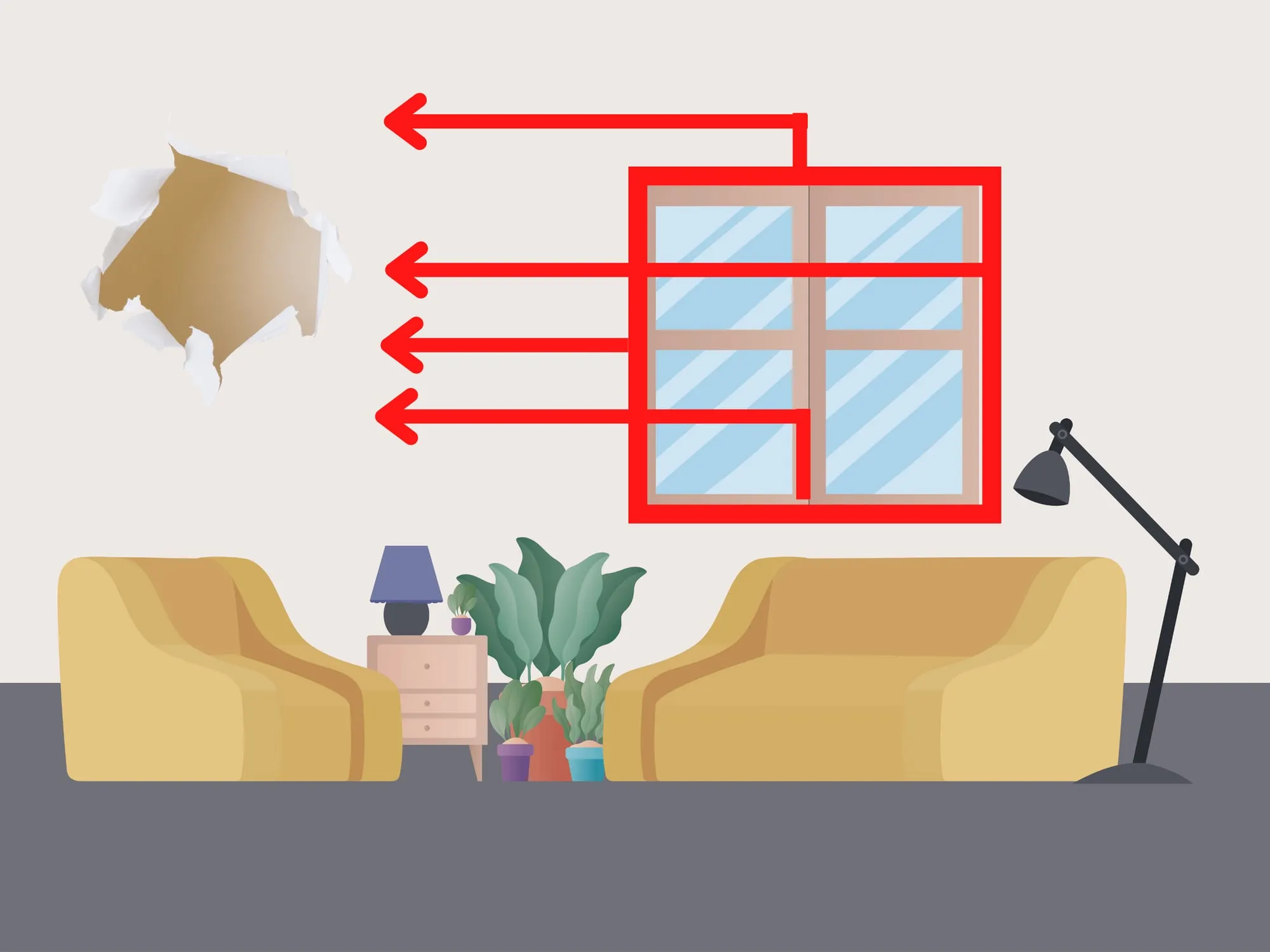
Air speed enters through draughts, which arise two ways. First, from gaps: unsealed windows, doors, letterboxes, loft hatches, disused chimneys. Second, from temperature difference: a cold surface such as single glazing sets up a downdraught of chilled air beside it, with no gap required at all.
Both are uncomfortable and both are expensive. People underestimate the first because the individual gaps look trivial — but a large number of small holes adds up to one substantial hole, and the air going through them is heat you paid for.
The second is addressed by warming the surface, which is where a radiant system helps directly. A wall or window reveal that is not markedly colder than the room does not generate a downdraught in the first place.
Keeping a building cool
Reverse the situation and air speed becomes an asset. Higher air speeds cool effectively, and a building designed for cross-ventilation can do a great deal of its own cooling without any electricity.
Insulation still pays: it slows the rate at which a space overheats and makes any air conditioning more effective. The trade-off is that a well-insulated space that has overheated takes longer, or more energy, to bring back down.
The practical summary
Seal the gaps, warm the cold surfaces, ventilate deliberately rather than accidentally, and avoid heating systems that have to blow air at you to work.
Get all four right and you have a building that is comfortable at a lower air temperature — which is where the energy saving actually comes from.