Far infrared heating: why 6 to 15 µm is the wavelength that matters
What wavelength does far infrared heating use? Why warm surfaces emit 6–15 µm, the same band as the human body, and what that means for comfort.
Every heater gives off infrared. A halogen bar does, a radiator does, and so do you. What makes them feel so different is the wavelength, and the wavelength is set by one thing: how hot the surface is.
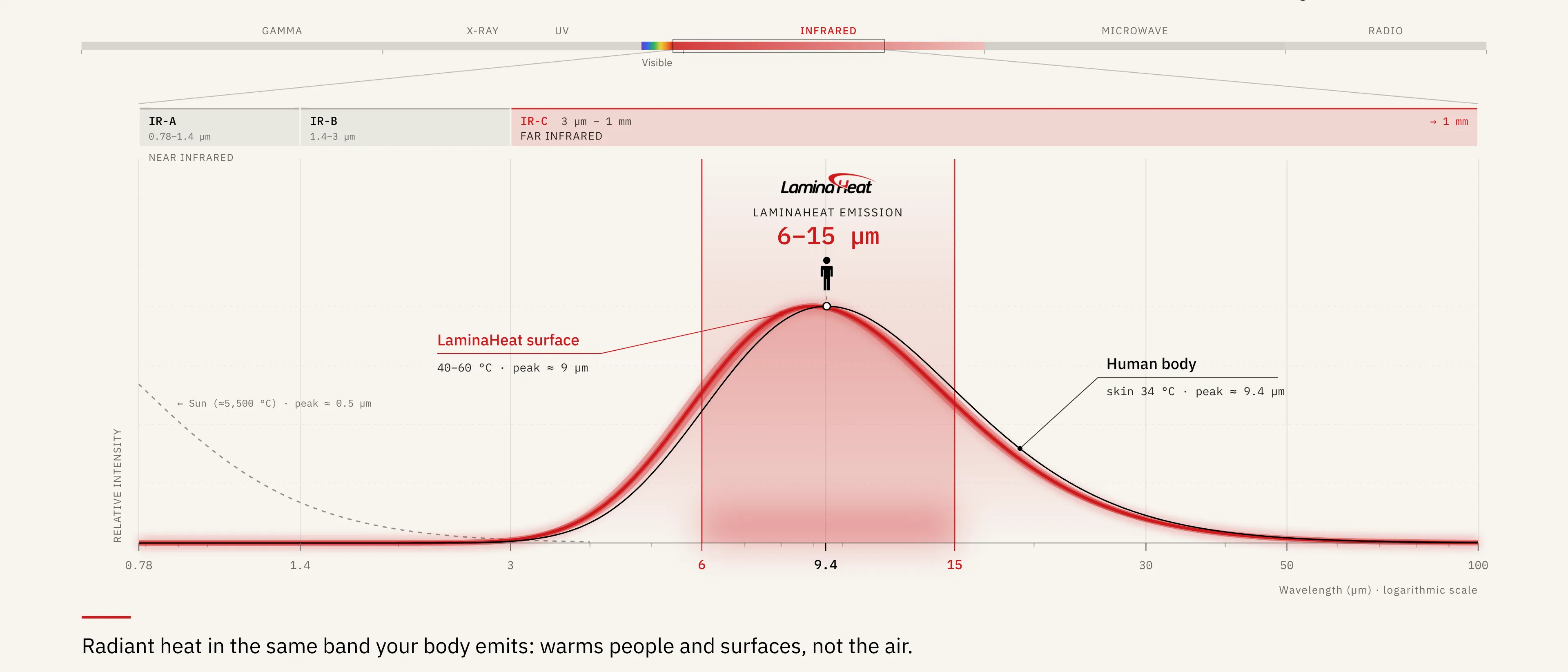
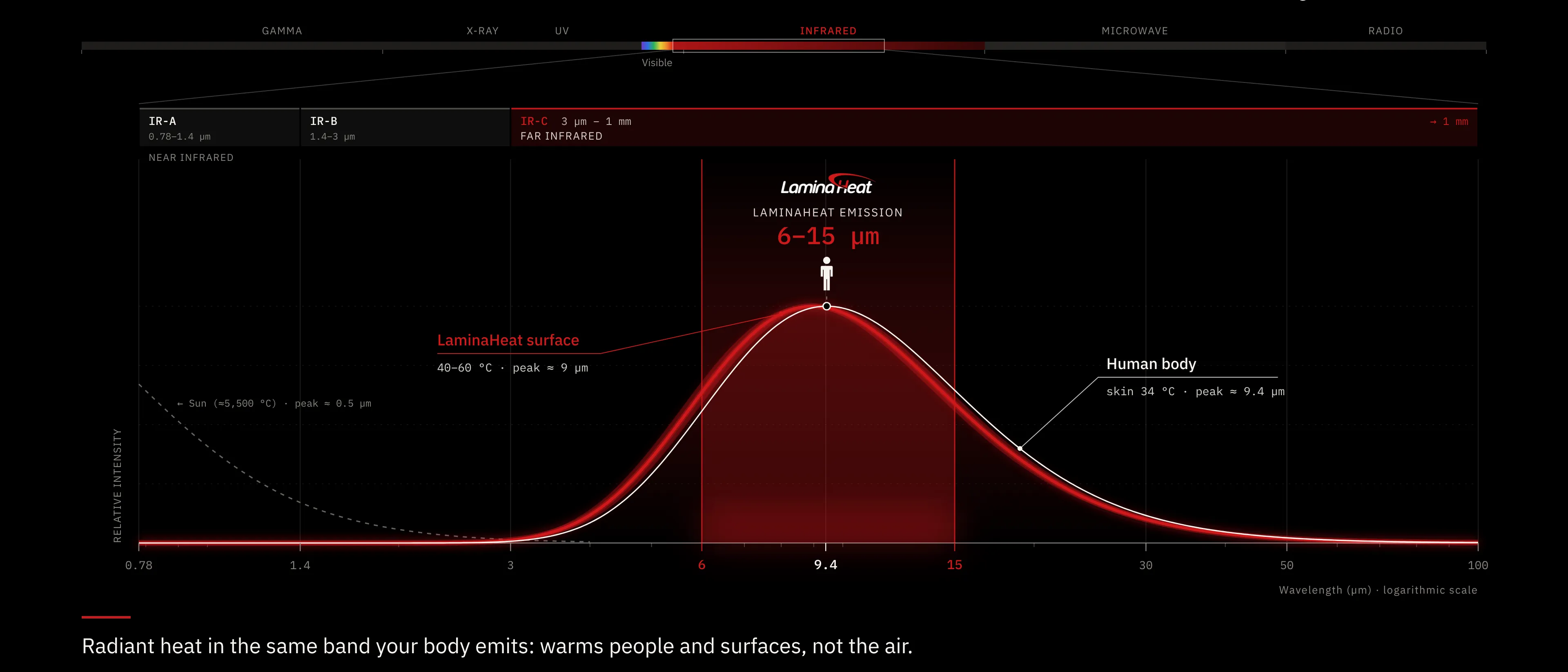
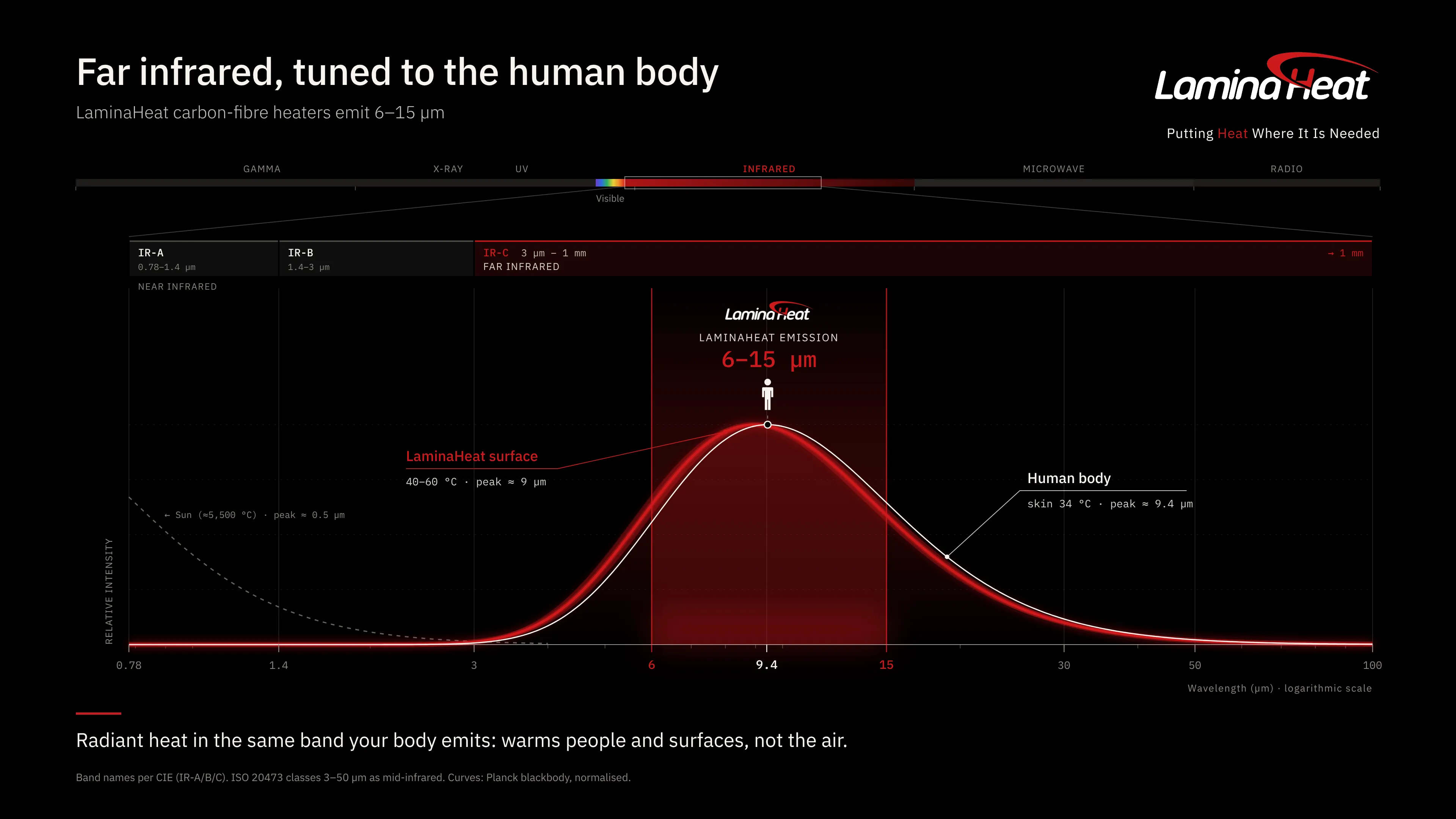
What wavelength is far infrared heating? A heated wall, ceiling or floor at 29 to 60 °C gives off long-wave infrared centred on about 9 µm, with its strongest output between 6 and 15 µm. That is the same band the human body gives off, peaking at about 9.4 µm. Short-wave heaters that glow, like halogen and quartz bars, work at 1 to 3 µm instead.
This guide explains where those numbers come from, why matching the body matters, and what it means when you choose a heater.
Temperature decides the wavelength
Anything warmer than absolute zero radiates. The hotter it is, the shorter the wavelength it radiates at, and the peak follows a simple rule from physics, Wien’s law: divide 2,898 by the surface temperature in kelvin and you get the peak wavelength in micrometres.
That one rule sorts every heater on the market:
| Source | Surface temperature | Peak wavelength | Band |
|---|---|---|---|
| The sun | about 5,500 °C | 0.5 µm | Visible |
| Halogen heater | about 2,200 °C | 1.2 µm | IR-A |
| Quartz or carbon lamp heater | 1,000–1,200 °C | 2.0–2.3 µm | IR-B |
| Ceramic or dark heater | 300–700 °C | 3.0–5.1 µm | IR-C |
| Wall-hung infrared panel | 90–110 °C | 7.6–8.0 µm | IR-C |
| PowerBoard 250 ceiling panel | 50–60 °C | 8.7–9.0 µm | IR-C |
| ComfortScrim wall or ceiling | 40–55 °C | 8.8–9.3 µm | IR-C |
| SafeTech EGS heated floor | under 29 °C | about 9.6 µm | IR-C |
| Human skin | about 34 °C | 9.4 µm | IR-C |
The pattern is plain. Small, very hot elements sit at the short-wave end. Large, gently warm surfaces sit right next to the human body. Our heating elements spread carbon fibre across the whole surface, so they never need to run hot, and they land in the same band as you.
What “mainly 6 to 15 µm” means
A warm surface doesn’t emit at a single wavelength. It emits a smooth curve, like the one in the chart. For a surface at around 50 °C, the curve peaks near 9 µm, a little over half of the energy falls between 6 and 15 µm, and about 97% falls between 3 and 50 µm.
So when we say our heaters emit at 6 to 15 µm, we mean that is where the curve is strongest, centred on the same peak as your body. There is nothing in the visible range, nothing in the ultraviolet, and the heater never glows.
Why it matters that it matches your body
It feels like warmth, not like a lamp. Long-wave infrared is absorbed in the outermost fraction of a millimetre of your skin, where your warmth sensors are. Short-wave infrared from a glowing element goes deeper and feels intense up close. Long-wave feels like standing in a warm room with sun-warmed walls.
It warms the whole room evenly. Plaster, wood, fabric, tiles and skin all absorb long-wave infrared very well. So the heat lands on whatever it reaches: you, the sofa, the other walls and the floor. Those surfaces warm up and give the warmth back, and the room’s surfaces end up close to each other in temperature. That is what makes a room feel comfortable at a lower air temperature, as explained in thermal comfort explained.
It doesn’t go straight out of the window. Ordinary window glass lets short-wave infrared through but blocks long-wave infrared beyond about 5 µm. Heat at 6 to 15 µm is absorbed by the glass rather than passing through it, so it stays in the room.
It replaces the heat your body is losing. Indoors, you lose most of your heat by radiating it to the cooler surfaces around you, in exactly this band. A warm ceiling or wall radiating back in the same band is the most direct way to stop that loss. That’s why a room with warm surfaces feels warmer than the thermostat says.
Is 6 to 15 µm really “far infrared”?
It depends on which standard you use, and it’s worth knowing so you aren’t confused by marketing.
- The CIE, the international lighting commission, splits infrared into IR-A (0.78–1.4 µm), IR-B (1.4–3 µm) and IR-C (3 µm to 1 mm). Under this scheme, 6 to 15 µm is IR-C.
- ISO 20473 splits it into near (0.78–3 µm), mid (3–50 µm) and far infrared (50 µm–1 mm). Under this scheme, 6 to 15 µm is mid-infrared.
- The heating industry generally says “far infrared” for long-wave heating in the IR-C band, and that is how most people search for it.
All three describe the same physics. We use IR-C and long-wave infrared for precision, and far infrared because that’s the term most people know. The difference between the three bands, and which heaters fall into each, is in IR-A, IR-B and IR-C: which infrared is right for indoor heating?
What this means when you choose a heater
If you want heating you live with for hours at a time, look for a large surface at a moderate temperature rather than a small element that glows. That is what puts the output in the same band as your body. The surface temperature on the datasheet tells you almost everything: below about 110 °C you are in long-wave territory, and the closer it gets to 30 to 60 °C, the closer it gets to the body’s own curve.
Our systems all sit in that range:
- ComfortScrim goes behind plaster on walls and ceilings and runs at 40 to 55 °C.
- PowerBoard panels fit into plasterboard ceilings and ceiling grids.
- SafeTech EGS goes under the floor finish and keeps the floor surface under 29 °C.
For the full picture of how radiant heating warms a room, read how does infrared heating work?. For questions about exposure, read are infrared heaters safe?. The short physics version is on our why infrared page.
Far infrared wavelength: your questions
What wavelength is far infrared heating?
Built-in infrared heating surfaces at 29 to 60 °C emit long-wave infrared that peaks at about 9 µm, with the strongest output between 6 and 15 µm. That is the same band the human body gives off, which peaks at about 9.4 µm.
What wavelength does the human body emit?
Skin at about 34 °C emits long-wave infrared that peaks at about 9.4 µm. Most of the energy falls between roughly 5 and 30 µm. Thermal cameras see people because they are tuned to this band.
Why does the surface temperature decide the wavelength?
Every surface radiates a spread of wavelengths, and the peak moves to shorter wavelengths as the surface gets hotter. This is Wien’s law: the peak wavelength in micrometres is about 2,898 divided by the temperature in kelvin. A surface at 50 °C peaks at about 9 µm. A halogen element at 2,200 °C peaks at about 1.2 µm.
Is 6 to 15 µm far infrared or mid infrared?
Both names are used. Under the CIE scheme it is IR-C, which runs from 3 µm to 1 mm. Under ISO 20473 it is mid-infrared, which runs from 3 to 50 µm. The heating industry commonly calls long-wave heating in this band far infrared.
Do far infrared heaters glow?
No. A surface has to reach several hundred degrees before it gives off visible light. Heating surfaces at 29 to 60 °C emit no visible light at all, so there is no glow and no glare.
Does far infrared heating give off UV?
No. Ultraviolet needs a source thousands of degrees hot, such as the sun. A heated wall, ceiling or floor at 29 to 60 °C emits no ultraviolet.
Does far infrared pass through windows?
Not directly. Ordinary window glass blocks infrared longer than about 5 µm. Long-wave heat at 6 to 15 µm is absorbed by the glass instead of passing through it, so it is not lost straight outside.
Why does long-wave infrared feel more comfortable than a halogen heater?
Long-wave infrared is absorbed in the outermost layer of the skin and is spread across a large surface, so it feels like gentle, even warmth. A halogen heater concentrates short-wave infrared from a small, glowing element, which feels intense up close and weak a few metres away.