Infrared heating for dental practices, beauty salons and treatment rooms
Why infrared heating suits dental practices, beauty and nail salons, massage, physio and aesthetics clinics: warm clients and comfortable staff in the same room, no fans blowing dust, silent, easy to clean and warm in time for the first appointment.
If you run a beauty salon, a dental practice, a massage or physio room, or an aesthetics clinic, you probably know this problem: your client is cold and your staff are too warm, in the same room, at the same time.
Your client is lying still, often half undressed or under a towel, for 30 minutes or more. Your therapist, dentist or nail tech is standing, moving and concentrating. Turn the heating up and the staff overheat. Turn it down and the client shivers. A fan heater in the corner doesn’t help, because it blows air (and nail dust, hair and powder) straight across the room.
Infrared heating is one of the few kinds of heating that can deal with both at once. Here’s why.
Warm the client without cooking the staff
Two people in the same room feel very different temperatures, because comfort depends on more than the air. How active you are and what you’re wearing matter just as much.
A client lying on a couch is barely producing any body heat and is losing heat from bare skin. A practitioner on their feet is producing a lot more. Heat the air enough for the client and the practitioner overheats.
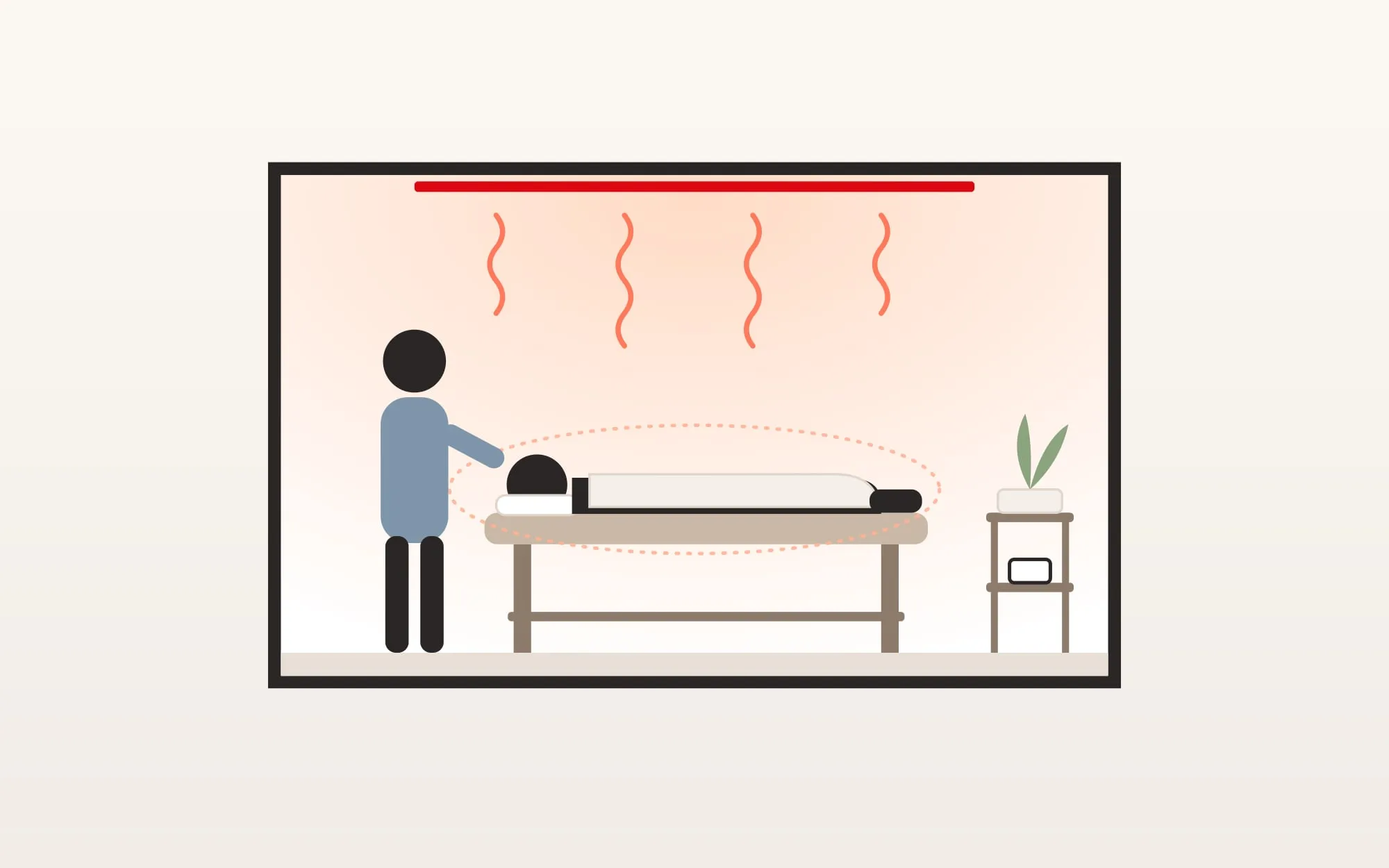
Radiant heat changes the balance. A heated ceiling above the couch warms whatever is facing it, and a client lying on their back is facing it directly. They feel warm on their skin, the same way you feel sunshine on a cold day, while the air stays comfortable for someone who is working. Most people are comfortable with the air 2 to 3 °C cooler when the surfaces around them are warm, and that’s exactly the room you want: cooler air for the staff, warm surfaces for the client. The science is in thermal comfort explained.
No fan, no draught, no dust blown around
Fan heaters, air-conditioning units and fan-coils move air around the room. In a salon or clinic that’s a problem:
- Nail salons: filing dust and acrylic dust get carried across the room.
- Hair, brows and lashes: loose hair, powder and product end up where you don’t want them, and anyone working with lash adhesive knows that moving air gets in the way.
- Treatment rooms: a draught across a client’s bare back or legs is the fastest way to make them uncomfortable.
- Dental surgeries: air movement is something you manage deliberately, not something the heating should add.
Infrared heating has no fan. It warms people and surfaces directly, and they warm the air gently. There’s none of the blowing that carries dust around the room, and no filters to clean. To be clear, it isn’t an air cleaner or an infection-control measure. It just doesn’t add air movement to the room.
Silent, which matters more than you’d think
No fan, no pump, no ticking pipes, no boiler firing up. For a massage room, a facial or a nervous dental patient, a silent room is part of the service. Infrared heating makes no sound at all.
Nothing on the walls, nothing to clean around
Treatment rooms are small, and every bit of wall is useful for cabinets, mirrors, shelves and equipment. Infrared heating goes behind the plaster, into the ceiling or under the floor, so there’s no radiator taking up space, no hot panel to bump a trolley or dental chair into, and no fins collecting dust behind a couch.
That makes cleaning simpler too. A heated wall or ceiling is just a wall or ceiling you wipe down like any other.
The surfaces stay warm, not hot. A heated floor stays under 29 °C, so it’s comfortable for bare feet at a pedicure station or spa. A heated ceiling is out of reach, and a heated wall runs at 40 to 55 °C, similar to a radiator.
Warm for the first appointment, off when the room is empty
Salons and practices run on appointments. The room needs to be warm when the client arrives, and there’s no point heating it when nobody’s booked.
A heated wall or ceiling is felt within 3 to 10 minutes and the room reaches temperature in 20 to 30. Every room has its own thermostat, and a schedule can warm each treatment room half an hour before the first booking and turn it down at lunch or when the room is empty. Reception, treatment rooms, the staff room and the toilets can all run on their own timings.
Wet rooms, spas and showers
Spa rooms, shower areas and wet treatment rooms need heating that’s safe around water. Our ComfortScrim runs at extra-low voltage, 12 to 48 V from a separate power supply, and under 24 V inside a shower enclosure, so it can go into the walls and floors of wet areas. We cover how that works in infrared heating for bathrooms.
Easy to fit in a rented unit or a quick refit
Most salons and practices are in rented units, and every day closed for building work is a day without income.
- No pipes and no boiler. Just the heating element, a thermostat per room and your electrician’s connections.
- Very thin. ComfortScrim adds just 2 to 3 mm under plaster or a floor finish.
- Quick in commercial ceilings. Our PowerBoard panels fit into a plasterboard ceiling or ceiling grid at about 12 minutes a board.
- Nothing to service. No annual boiler service and no filters. The elements are tested for a lifespan of more than 20 years and carry a 10-year warranty.
What about running costs?
Two things work in your favour in a salon or practice. The air can be 2 to 3 °C cooler for the same comfort, which saves roughly 6% of heating energy per degree. And rooms that aren’t booked don’t need heating at all. Electricity usually costs more per kilowatt hour than gas, so the saving comes from heating less, not from cheaper energy. We go through real numbers in is infrared heating cost effective?
Which system for which room?
| Space | What we’d usually suggest |
|---|---|
| Treatment rooms, massage, facials | Heated ceiling above the couch |
| Dental surgery | Heated ceiling, clear of the operating light and equipment |
| Nail and pedicure stations | Heated floor for bare feet, ceiling for the rest of the room |
| Hair salon floor | Heated ceiling or walls |
| Spa, shower and wet rooms | ComfortScrim in walls and floor at extra-low voltage |
| Reception and waiting area | Heated ceiling or floor |
Every building is different, so we’ll design the layout room by room.
If you’d like to know how it all works, how does infrared heating work? walks through it, and are infrared heaters safe? covers the certifications and tests.
Infrared heating for salons and practices: your questions
Is infrared heating good for beauty salons?
Yes. It warms clients lying still on a couch without overheating staff who are on their feet, it has no fan to blow nail dust, hair or powder around, it is silent, and it takes up no wall space. Each room can be heated on its own schedule, around appointments.
Is infrared heating suitable for a dental practice?
Yes. A heated ceiling keeps patients comfortable in the chair while staff work in cooler air. It has no fan and does not move air around the surgery, there is nothing on the walls to clean around or bump equipment into, and each surgery has its own thermostat.
How do I keep clients warm in a treatment room without overheating staff?
Use radiant heat. A heated ceiling above the couch warms a client lying on their back directly, like sunshine, while the air stays cooler for staff who are moving around. Most people are comfortable with the air 2 to 3 °C cooler when the surfaces around them are warm.
Does infrared heating blow dust around?
No. Infrared heating has no fan and does not rely on circulating air. It warms people and surfaces directly, so nail dust, hair and powder are not carried across the room by the heating.
How quickly does infrared heating warm a treatment room?
A heated wall or ceiling is felt within 3 to 10 minutes and the room reaches its set temperature in about 20 to 30 minutes. A schedule can start each room half an hour before its first appointment.
Can infrared heating go in a spa or shower room?
Yes. ComfortScrim runs at 12 to 48 V from a separate power supply, and under 24 V inside a shower enclosure, so it can be built into the walls and floors of wet areas.
Is infrared heating a health treatment?
No. Our infrared heating is a building heating system, not a therapy or medical device, and we make no health claims for it. It keeps clients and staff comfortable.