Infrared heating for yoga studios: warm, quiet and quick to install
How to heat a yoga studio with infrared ceiling panels: warm students on the mat, no fans or draughts, fast heat-up before class, quick installation and what to plan for.
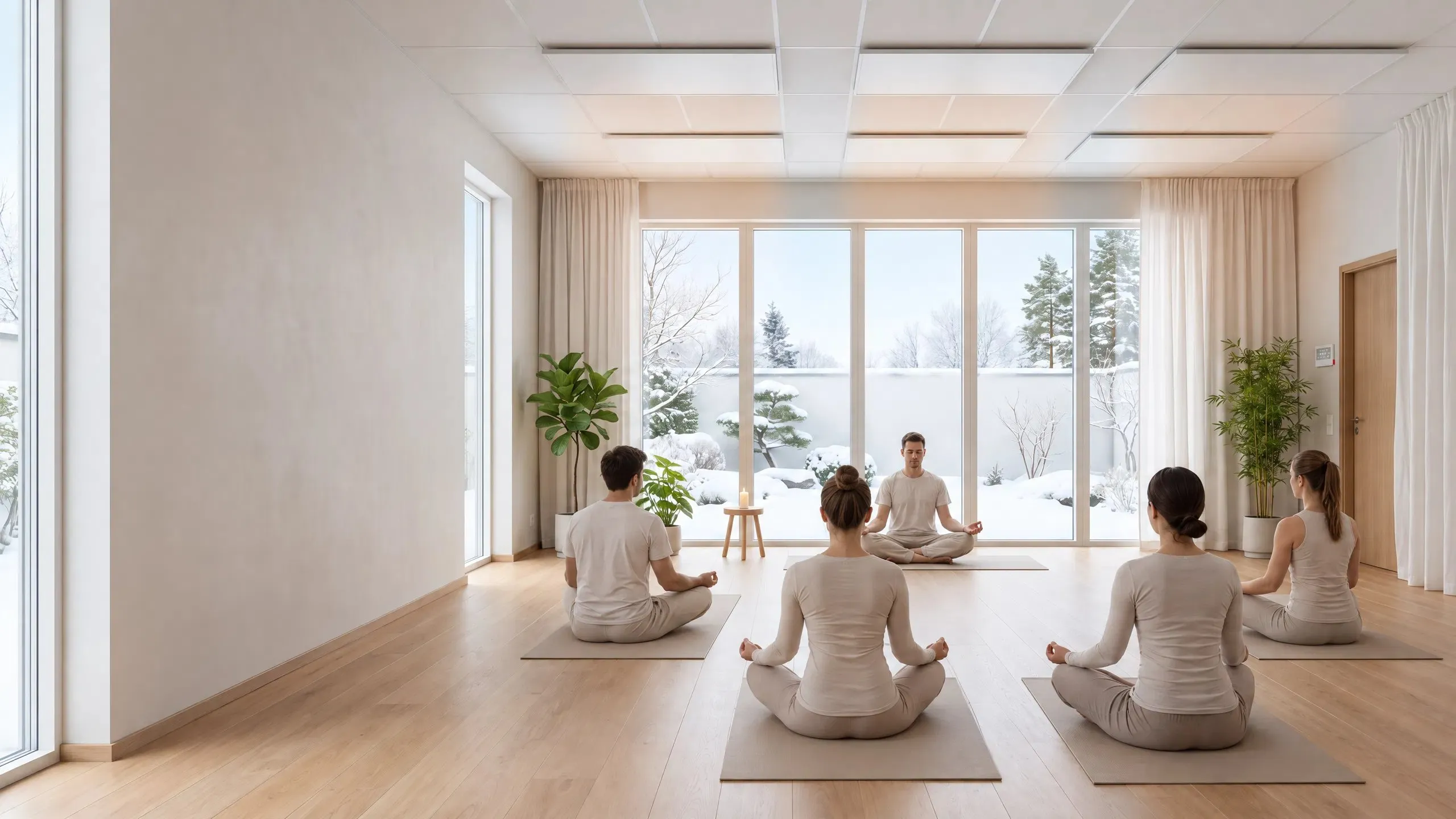
Heating a yoga studio is harder than it looks. Your students sit and lie still on a mat for long stretches, in light clothing and often barefoot. Then they move, warm up and want cooler air. The room is empty for hours between classes, and full the moment a class starts. And the whole point of the room is calm, so a noisy fan heater or an air conditioner blowing across the floor works against you.
Infrared heating suits this kind of room well. It warms people and surfaces directly, makes no noise, moves no air and reaches temperature quickly. This guide covers why it works in a yoga studio, how quickly it warms up, how it’s installed, how we design a layout, and the issues worth planning for before you start.
Why infrared heating suits a yoga studio
It warms people on the mat, not just the air. Comfort depends on more than air temperature. Someone lying still in a savasana produces very little body heat, while the same person in a flowing sequence produces a lot more. Warm air rises to the ceiling and leaves the floor, where your students are, as the coolest part of the room. Radiant heat works the other way round: a heated ceiling warms whatever faces it, and a student lying on their back faces it directly. The science is in thermal comfort explained.
No draughts and no fan noise. Infrared panels have no fan and don’t rely on circulating air. Nothing blows over damp skin after a strong sequence, candle flames stay still, and the room is silent during meditation and breathwork.
Cooler air for the same comfort. Most people are comfortable with the air 2 to 3 °C cooler when the surfaces around them are warm. That gives you a room that feels warm when students are still, without feeling stuffy when they move.
Nothing on the walls or floor. The panels sit on the ceiling, so there are no radiators to take up wall space, no hot surfaces next to the mats, and no fins collecting dust in the corners. Your walls stay free for mirrors, props, shelves and bolster storage.
Fast heat-up before every class
Yoga studios run on a timetable. The room needs to be warm when students walk in, and there’s little point heating it through a three-hour gap between the morning and evening classes.
Radiant heat is felt within 3 to 10 minutes of switching on, and the room reaches temperature in 20 to 30 minutes. A slow system like a wet underfloor screed can take hours, so it ends up running all day. With infrared, a schedule on the thermostat can start the heating half an hour before the first class, turn it down in the gaps, and switch it off after the last session. Separate studios, the changing rooms and reception can each run on their own timings.
Quick and simple installation
Most studios are in rented units, converted warehouses or upper floors of commercial buildings, and every day closed for building work is a day without classes. Our PowerBoard panels are made for this.
- No pipes, no boiler and no wet trades. Just the panels, a thermostat per zone and your electrician’s connections.
- Surface-mounted or suspended. PowerBoard 500 and 750 are fixed to the finished ceiling on brackets, suspended on wires from a high or exposed ceiling, or fitted into an industrial suspended ceiling. You don’t need to rebuild the ceiling.
- About 12 minutes a board. Each panel is a standard 1200 × 600 mm module, wired back to a connection box. Most studios can be fitted in a day or two, often outside class hours.
- Tested before handover. The installer records resistance and insulation tests for each zone, so you have a record of a sound installation.
- Nothing to service. No annual boiler service, no filters and no moving parts. The panels are tested for a lifespan of more than 20 years and carry a 10-year warranty.
The PowerBoard installation guide walks through the steps in more detail.
Project example: a yoga studio in Taiwan
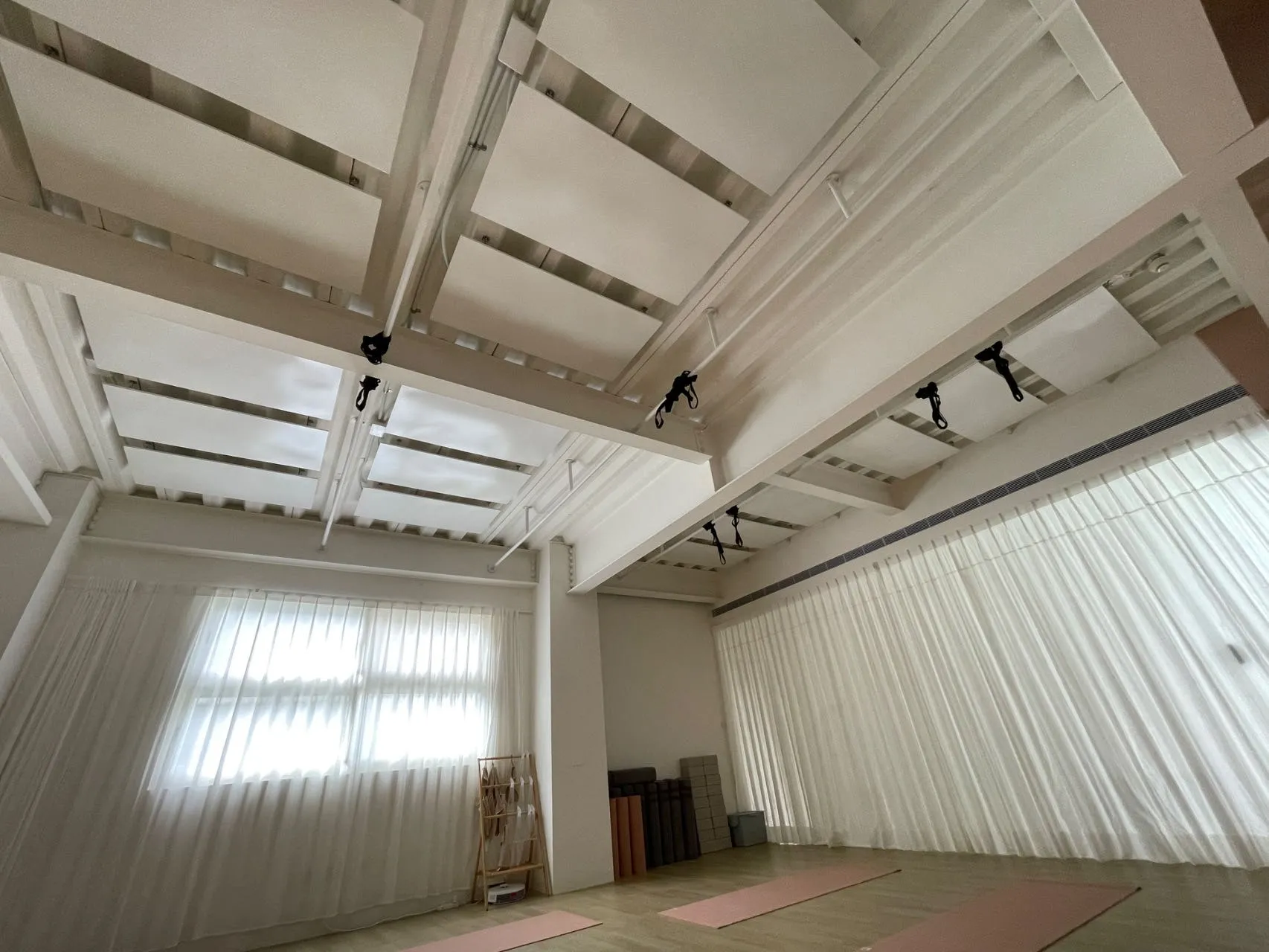
This studio in Taiwan has a high ceiling with exposed steel beams, which also carry the anchor points for aerial yoga. Rebuilding that ceiling to hide a heating system would have been expensive and would have got in the way of the aerial rigging.
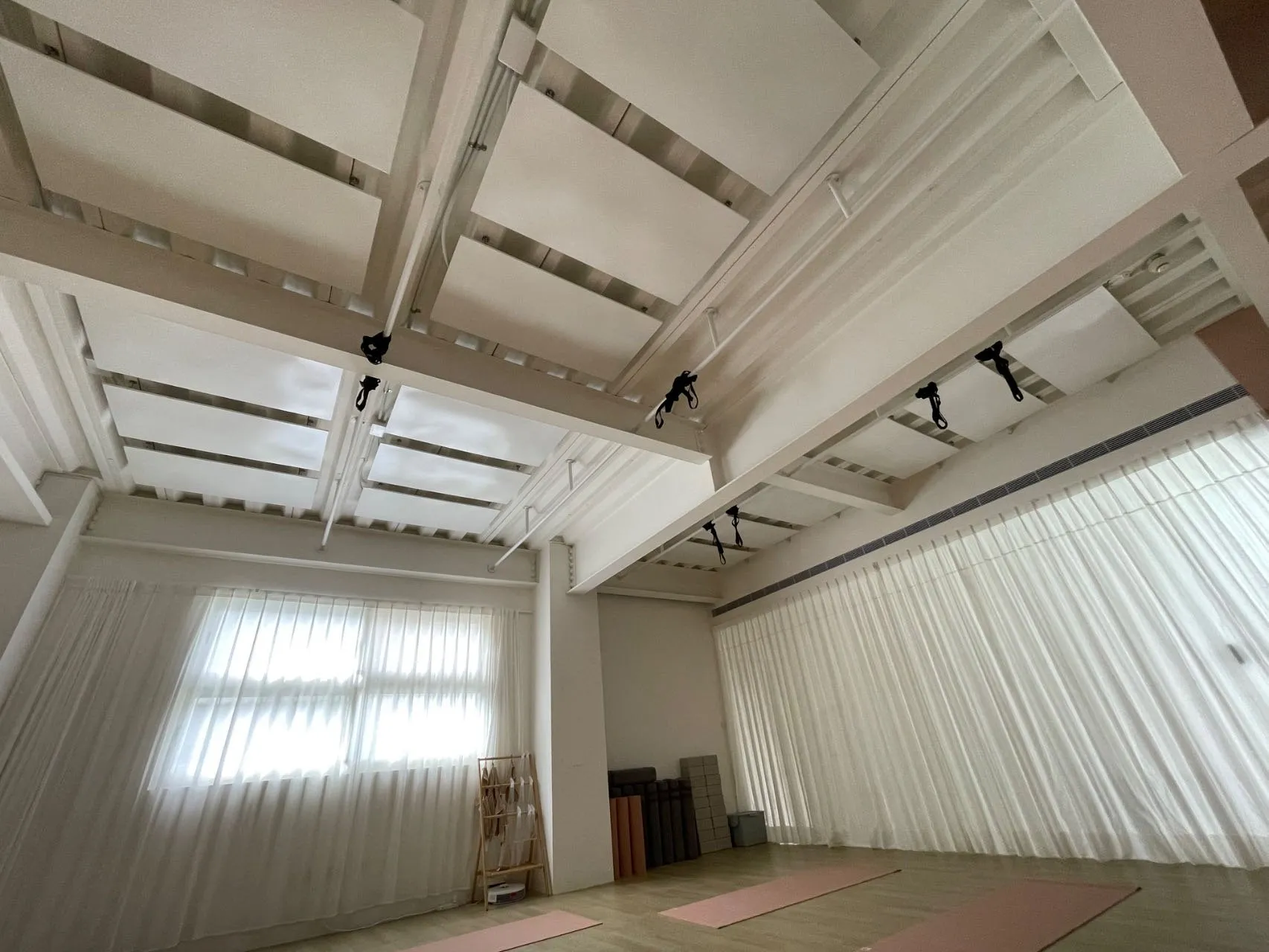
Instead, PowerBoard 750 panels were mounted in rows between the beams, set out so they sit over the practice area and stay clear of the aerial yoga straps. The existing ducted air conditioning stays in place for summer cooling, and the panels take over the heating in winter, without blowing air across the room.
How we design the heating for a yoga studio
Every studio is different, so we design the layout room by room from your floor plan. These are the things we look at.
Ceiling height and panel choice. PowerBoard 500 and 750 run at 80 to 105 °C. That’s fine high up, but a student lying directly under a panel on a low ceiling for a long savasana could feel too much warmth on their face. So we set the panels as high as the room allows and choose the size to suit the ceiling. PowerBoard 750 suits high and open ceilings, as in the Taiwan studio. On a lower ceiling we usually use more PowerBoard 500 panels spread across the room, so the warmth is shared out rather than concentrated in a few spots.
Even warmth across the mats. Panels are spread over the area where students practise rather than bunched in one spot, so every mat gets a similar amount of warmth. Comfort standards (ASHRAE 55) recommend keeping the difference between a warm ceiling and the rest of the room within limits, and the layout is designed to stay inside them.
Heat output for the room. We size the system from the room’s heat loss: floor area, ceiling height, insulation, windows and how cold your winters get. A studio with large glazing or a poorly insulated roof needs more output, and if a room would need more than about 150 W/m², we recommend improving the insulation first. Our guide to calculating heat coverage explains the method.
Zones and controls. One thermostat runs up to 4 PowerBoard 750 or up to 7 PowerBoard 500. A large studio is split into zones, for example the front and back of the room, or a main studio and a smaller private room, each on its own thermostat and schedule.
Everything else on the ceiling. Aerial yoga anchors, lights, speakers, sprinklers, smoke detectors and air conditioning outlets all need space. We plan the panels around them and keep the required clearances.
Warm floor as an option. If you want the floor itself to feel warm under bare feet, our SafeTech EGS underfloor film can be added under the floor finish, kept below 29 °C. Most studios are comfortable with a heated ceiling alone.
Issues that can come up, and how to avoid them
Most problems with heating a yoga studio come from decisions made before the panels go up. These are the ones we see most often.
- Hot panels on a low ceiling. A surface-mounted panel low over the mats can feel too warm on the face. Mount panels as high as possible, use more PowerBoard 500 panels on lower ceilings, and keep PowerBoard 750 for high ceilings.
- Too few panels. Fewer, hotter panels to save money leave warm and cool spots across the room. Spreading the output more evenly gives a better result.
- Fabric touching the panels. Aerial hammocks, silks, drapes and decorations must not touch or hang over the panels. Plan the rigging and the heating together.
- Electrical capacity. Each panel draws 500 or 750 W, so a full studio adds up. Your electrician should confirm the supply and plan dedicated circuits before installation.
- Heat loss through glazing and roofs. Large windows and uninsulated roofs lose heat fast. Blinds, curtains and insulation reduce the output you need and the running costs.
- Ventilation is still needed. Infrared heats, it doesn’t ventilate. A full class needs fresh air, and your existing ventilation or air conditioning keeps doing that job.
- Hot yoga is a separate design. Classes held at 35 to 40 °C, often with added humidity, need much more output, plus careful ventilation and moisture control. We size hot yoga rooms individually rather than using the figures for a normal studio.
What about running costs?
Two things work in a studio’s favour. The air can be 2 to 3 °C cooler for the same comfort, which saves roughly 6% of heating energy per degree. And because the room warms up quickly, it only needs heating for classes, not all day. Electricity usually costs more per kilowatt hour than gas, so the saving comes from heating less, not from cheaper energy. We go through real numbers in is infrared heating cost effective? and infrared heating running costs.
Safe and certified
PowerBoard is CE and UKCA marked, tested by BEAB to IEC 60335-1, and every panel is HIPOT tested before it leaves the factory. Read more in PowerBoard is BEAB certified and are infrared heaters safe?
Which system for which space?
| Space | What we’d usually suggest |
|---|---|
| Yoga studio with a high or exposed ceiling | PowerBoard 750, surface-mounted or suspended |
| Yoga studio with a lower ceiling | More PowerBoard 500 panels, spread across the room |
| Studio in an office building with a grid ceiling | PowerBoard fitted into the suspended ceiling |
| Floor where students want warm feet | SafeTech EGS underfloor film, under 29 °C |
| Changing rooms and reception | Heated ceiling on its own thermostat |
| Hot yoga room | Designed individually, with ventilation and humidity |
If you’d like to know how it all works, how does infrared heating work? walks through it, and infrared heating panels explains what to look for when comparing panels.
Infrared heating for yoga studios: your questions
Is infrared heating good for a yoga studio?
Yes. Infrared warms students on the mat directly, has no fan to cause draughts or noise, takes up no wall or floor space, and reaches temperature in 20 to 30 minutes, so the studio can be heated around the class timetable.
What is the best way to heat a yoga studio?
For most studios, radiant ceiling heating. It warms people lying and sitting on the floor, keeps the room silent and draught-free, and lets the air stay 2 to 3 °C cooler for the same comfort. We use PowerBoard 750 panels on high ceilings and more PowerBoard 500 panels, spread across the room, on lower ceilings.
How quickly does infrared heating warm a yoga studio?
Radiant warmth is felt within 3 to 10 minutes and the room reaches its set temperature in about 20 to 30 minutes. A thermostat schedule can start the heating half an hour before the first class.
How are infrared panels installed in a yoga studio?
PowerBoard 500 and 750 panels are surface-mounted to the ceiling on brackets, suspended on wires or fitted into a suspended ceiling, at about 12 minutes a board. They are wired back to connection boxes and a thermostat per zone. There are no pipes or boiler.
How many infrared panels does a yoga studio need?
It depends on floor area, ceiling height, insulation, windows and climate. We calculate it from your floor plan. One thermostat runs up to 4 PowerBoard 750 or 7 PowerBoard 500, and larger studios are split into zones.
Can infrared panels be used with aerial yoga?
Yes, if the panels and rigging are planned together. In our Taiwan studio the panels sit between the beams that carry the aerial anchors. Hammocks and fabric must not touch or hang over the panels.
Can infrared heating be used for hot yoga?
It can, but a hot yoga room at 35 to 40 °C needs far more output than a normal studio, plus careful ventilation and humidity control. We size these rooms individually.
Is infrared heating a health treatment?
No. Our infrared heating is a building heating system, not a therapy or medical device, and we make no health claims for it. It keeps your students and teachers comfortable.